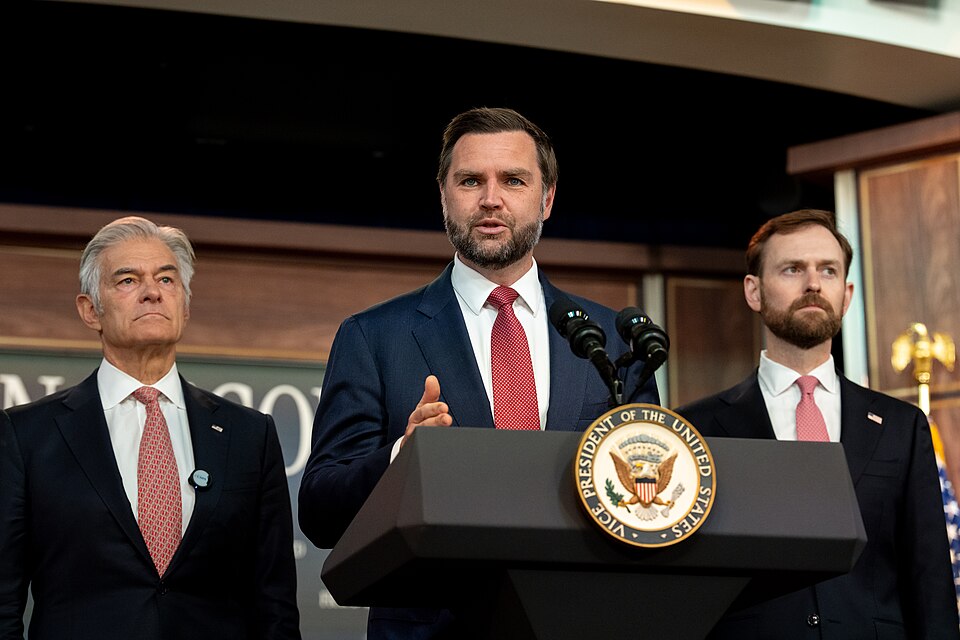
Here’s what was said.
Vice President JD Vance is escalating the debate over foreign workers in the United States, saying he would support eliminating the H-1B visa program altogether as the Trump administration continues tightening rules surrounding skilled-worker visas.
The H-1B program has long been used by technology companies, engineering firms, hospitals, accounting firms and other employers seeking foreign professionals for specialized positions.
But critics argue the system has increasingly been used to fill jobs that could otherwise go to qualified American workers.
Vance said Thursday that he believes the program has become deeply flawed.
“My view is, the H-1B program is completely broken, and I’d be very supportive of just eliminating it,” Vance said during an interview aboard Air Force Two.
He added that, as long as the program remains in place, the federal government should focus on preventing American workers from being displaced by lower-cost foreign labor.
Vance Takes Aim at H-1B Visa Program
Vance argued that abuse of the H-1B system is not limited to Silicon Valley.
He said technology companies, accounting firms and other businesses have taken advantage of the program in ways that can hurt American employees.
The vice president’s comments are significant because the H-1B issue has become one of the most contentious immigration and employment debates inside the Republican coalition.
Some conservatives want the program dramatically reduced or eliminated.
Others argue that American companies need access to highly skilled workers from around the world in order to remain competitive.
Vance clearly placed himself on the side calling for far-reaching reform.
What Is an H-1B Visa?
The H-1B visa allows American employers to temporarily hire foreign workers for specialized occupations.
Those positions commonly include jobs in:
- Technology
- Engineering
- Healthcare
- Finance
- Accounting
- Scientific research
Applicants generally must have at least a bachelor’s degree or equivalent qualifications related to the position.
H-1B visas are typically approved for three years and may generally be extended for additional time under federal immigration rules.
Supporters say the program helps businesses find specialized talent when qualified American workers are difficult to recruit.
Critics say some companies use the system to reduce labor costs or replace American employees.
That disagreement has placed the program at the center of a broader national debate over immigration, wages and employment.
Trump Administration Has Already Tightened H-1B Rules
President Donald Trump has not eliminated the H-1B program.
However, his administration has pursued tougher restrictions intended to discourage employers from using foreign workers simply because they may cost less than American employees.
One of the administration’s most aggressive moves involved imposing a $100,000 fee on certain H-1B applicants.
Vance said the policy was developed after discussions involving himself, Trump and senior White House adviser Stephen Miller.
According to Vance, the reasoning was straightforward.
If a company is trying to replace an American accountant or another professional with a cheaper foreign worker, he argued, the additional cost could eliminate the financial incentive.
Companies seeking exceptionally valuable or difficult-to-find talent, meanwhile, might still be willing to pay the fee.
Vance described the policy as a way to ensure the visa program is being used for its original purpose rather than simply lowering payroll costs.
Court Blocks Major Trump H-1B Policy
Trump’s efforts to tighten the H-1B system have also encountered legal challenges.
A federal judge blocked the administration from implementing the $100,000 fee for certain H-1B applicants.
The ruling represented another legal setback for the administration’s effort to dramatically increase the cost of bringing some foreign workers into the country.
The court battle means the future of the policy remains uncertain.
Additional litigation, appeals or congressional action could ultimately determine how far the administration can go in restricting the program.
Conservatives Split Over Foreign Workers
The H-1B controversy has created an unusual divide among Republicans and prominent conservative figures.
Immigration-focused conservatives argue that companies should be required to recruit American workers before looking overseas.
They contend that American graduates and experienced professionals should not have to compete against foreign workers brought into the country through a government visa program.
Technology executives and other business leaders offer a different argument.
They say the United States does not always produce enough workers with the highly specialized skills needed in rapidly growing industries.
Elon Musk has previously defended bringing exceptionally talented foreign engineers into the United States while also acknowledging concerns that some outsourcing companies can manipulate the visa system.
Vivek Ramaswamy has similarly defended the technology industry’s reliance on foreign-born talent.
Those positions have drawn criticism from conservatives who believe American companies should do more to recruit and train workers already living in the United States.
Vance Says Congress Should Act
Vance acknowledged that many Americans are frustrated with the H-1B program.
He said Congress ultimately has the power to make sweeping changes to the law.
“What I would say is, tell your congressman to fix this program,” Vance said.
In the meantime, he said the Trump administration would continue trying to reduce what it considers abuse of the existing system.
That distinction matters.
Vance is advocating eliminating H-1B visas, but the Trump administration has not announced that the program itself is being abolished.
Instead, the White House has focused on tougher rules, higher costs and additional scrutiny.
Could Trump Eliminate H-1B Visas?
Completely eliminating the H-1B program would be considerably more complicated than imposing additional restrictions.
The visa category exists under federal immigration law, meaning Congress would likely play a major role in any attempt to permanently abolish it.
That could make the issue an important legislative battle in Washington.
For now, Vance’s comments signal that at least some senior figures inside the Trump administration favor going much further than the restrictions already imposed.
The debate also raises a larger question about the future of America’s workforce.
Should employers continue receiving access to foreign workers for specialized jobs, or should federal immigration policy place greater emphasis on ensuring those positions go to qualified Americans first?
That question is likely to remain at the center of the H-1B debate as the Trump administration continues pushing for changes to the nation’s immigration and employment policies.