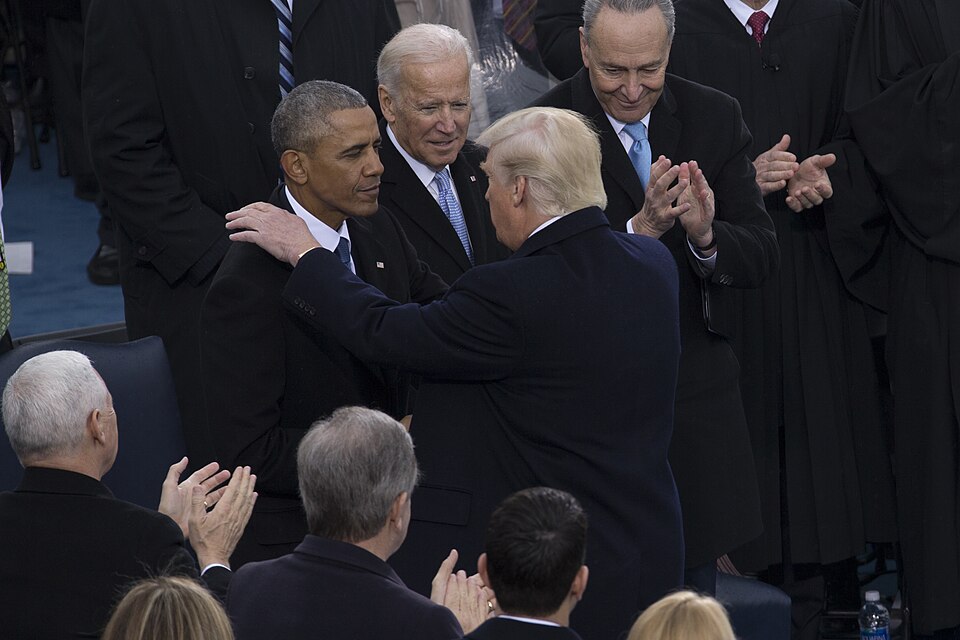
President Donald Trump delivered a sharp response after former President Barack Obama suggested that governments around the world might perform better if women were placed in charge for two years.
The exchange quickly attracted attention because it raised a broader question about political leadership, gender and whether any one group can be expected to govern more effectively than another.
Trump rejected Obama’s suggestion while emphasizing his respect for women.
Obama Makes a Bold Claim About Government Leadership
During a recent public appearance, Obama discussed what he believes might happen if women temporarily controlled governments around the world.
Obama said that even while serving as president, he sometimes imagined what the results would look like if women were placed in charge of every government for approximately two years.
He acknowledged that such governments would not be perfect, but said he believed conditions would improve overall.
The former president’s comments immediately opened the door to debate over whether leadership effectiveness can reasonably be connected to gender.
Political leaders of both sexes have produced widely different records throughout history, and their decisions are often shaped by ideology, experience, governing philosophy and the circumstances they face in office.
Trump Quickly Rejects Obama’s Suggestion
Trump was later asked by a reporter whether he agreed with Obama’s assessment.
He did not.
Trump called the statement “ridiculous” before making clear that his criticism was directed at Obama’s broader argument.
“I love women, I think they’re great,” Trump said.
Trump’s response suggested that he disagrees with the idea that governments would necessarily improve simply because women replaced men in positions of authority.
The exchange represents a significant philosophical difference between the two former political rivals.
Obama suggested that changing the gender makeup of government leadership could produce better outcomes.
Trump rejected the idea that gender by itself determines whether someone will govern successfully.
Debate Goes Beyond Men Versus Women
The controversy raises a larger issue that extends well beyond the personalities of Trump and Obama.
Women already hold powerful positions throughout American government, business, law, education and the military.
At the same time, female political leaders represent a wide range of ideological viewpoints.
Some support conservative policies on taxes, immigration, energy and national security. Others favor progressive approaches on those same issues.
That political diversity makes it difficult to assume that women as a group would govern in one particular way.
For many Americans, the more important questions concern a leader’s policies, experience, judgment and record in office.
Obama’s Remark Is Not Entirely New
Obama has previously expressed the belief that greater female leadership could improve political institutions.
His latest remarks therefore fit into a broader argument he has made about generational change and representation in government.
Supporters of increased female representation often argue that government benefits when leadership includes people with different backgrounds and experiences.
Others argue that representation should not become a substitute for evaluating individual qualifications, policies and results.
That distinction helps explain why Obama’s latest statement generated such a strong reaction.
Trump Has Frequently Clashed With Female Reporters
Trump’s comments also attracted attention because of his history of heated exchanges with members of the press, including several prominent female journalists.
During his political career, Trump has publicly criticized reporters including CNN’s Kaitlan Collins, ABC News’ Rachel Scott and others who have challenged him during press conferences or interviews.
His critics have argued that some of his language toward female journalists has crossed the line into personal attacks.
Trump and his supporters have generally characterized those clashes as disputes over media coverage rather than gender.
The distinction remains part of the larger debate surrounding Trump’s relationship with the national press.
Leadership Remains a Question of Policies and Results
Obama’s statement ultimately presents voters with an interesting political question.
Would changing the demographic makeup of government automatically improve the way governments operate?
Obama believes greater female leadership could produce better results.
Trump rejects that assumption.
The disagreement highlights two very different approaches to evaluating political leadership.
One emphasizes representation and the possibility that different life experiences could influence governing decisions.
The other emphasizes evaluating leaders individually based on their policies, qualifications and performance.
For voters, those questions are likely to remain important regardless of whether the person holding office is a man or a woman.
Why This Exchange Matters
The argument comes at a time when Americans remain divided over major issues including inflation, immigration, taxes, government spending, foreign policy and public safety.
Those issues affect families far more directly than political hypotheticals.
That is why Obama’s comments — and Trump’s immediate response — have generated attention beyond the original exchange.
The controversy raises a question that voters have confronted for generations: What qualities actually make someone an effective leader?
For Obama, increasing the number of women in positions of power could be part of the answer.
Trump clearly sees the issue differently.
Ultimately, voters will continue deciding which leaders they trust based on their own priorities, values and assessment of each candidate’s record.