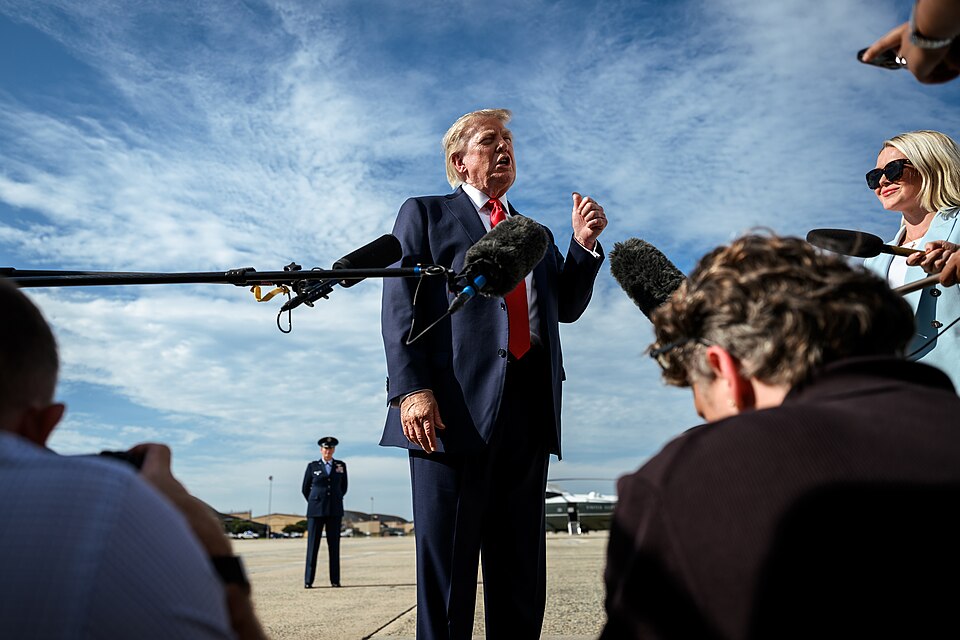
Trump made his opinion very clear.
President Donald Trump is warning Europe that it could face major new tariffs if the European Union moves forward with a plan to build a much closer relationship with Canada.
The president said Wednesday that he could view a proposed arrangement making Canada the European Union’s first “associate member” as a hostile economic move against the United States.
Speaking to reporters in North Carolina, Trump warned that if he viewed the move as hostile toward the United States, he could respond with steep tariffs or even halt trade with Europe.
Trump also dismissed the Canada-EU proposal as “laughable” and renewed his criticism of Canada’s trade relationship with the United States.
But the president left open the possibility that Washington could accept the arrangement if he determines that it is not intended to damage American economic interests.
“If it’s a good intention, that’s fine,” Trump said. “If it’s a bad intention, we’ll put very heavy tariffs on Europe.”
The remarks raise the possibility of another major trade confrontation involving the United States, Canada and Europe at a time when tariffs are already reshaping international commerce.
Trump Warns Europe Over Canada Deal
European Commission President Ursula von der Leyen announced this week that she wants Canada to become the European Union’s first associate member.
The idea would create an entirely new type of relationship between Canada and the EU.
Canada would not become a full European Union member under the proposal. Instead, the arrangement could lead to deeper cooperation involving trade, defense, energy, technology and other strategic industries.
Exactly what “associate membership” would mean has not yet been finalized, and European governments would still need to determine how such an arrangement would work.
For Trump, however, the proposal immediately raised concerns about its possible impact on the United States.
His warning suggests that Washington could respond economically if the administration concludes that closer Canada-EU ties threaten American trade interests.
Canada Moves Closer To Europe
Canadian Prime Minister Mark Carney has welcomed efforts to strengthen relations with Europe.
Speaking before the European Parliament on Thursday, Carney called for deeper cooperation in several strategically important areas, including critical minerals, artificial intelligence, defense manufacturing and energy security.
Carney argued that Canada should develop stronger international partnerships so that its economy is not overly dependent on a single country.
That represents an important shift for a nation whose economy has historically been closely connected to the United States.
Canada sends a large share of its exports to the American market, making developments in U.S.-Canada trade policy particularly important for manufacturers, energy producers, farmers and consumers on both sides of the border.
Carney has increasingly argued that Canada needs a broader network of trading partners as economic tensions with Washington continue.
Tariff Battle Raises Economic Stakes
The dispute comes during a broader period of trade tension between the United States and Canada.
Trump has imposed substantial tariffs on Canadian products, while Ottawa has responded with retaliatory measures of its own.
Industries including steel, aluminum, automobiles, manufacturing and energy can be especially sensitive to tariffs because production and supply chains frequently cross the U.S.-Canada border.
Higher tariffs can raise the cost of imported goods, alter supply chains and influence prices paid by businesses and consumers.
Supporters of tariffs often argue that they can protect domestic industries, encourage companies to manufacture more products at home and provide governments with leverage during trade negotiations.
Critics counter that tariffs can increase costs for businesses and consumers while inviting retaliation from foreign governments.
Those competing economic arguments are likely to become even more important if the trade dispute expands to include Europe.
Europe Could Become The Next Trade Front
Trump’s warning significantly raises the stakes surrounding the proposed Canada-EU partnership.
The European Union represents one of the world’s largest economic markets, and trade between the United States and Europe covers an enormous range of products and services.
Any major escalation in tariffs could therefore have consequences extending far beyond Canada.
American manufacturers, exporters, farmers and multinational companies could all be affected by changes in trade policy between Washington and Brussels.
European officials, meanwhile, have described closer ties with Canada as an effort to strengthen economic and strategic cooperation rather than a move specifically aimed at the United States.
The proposed associate membership remains at an early stage, meaning many important details still have to be negotiated.
Why Canada Wants More Trading Partners
Canada’s push toward Europe comes as its government reevaluates decades of close economic integration with the United States.
Carney has said that Canada became too dependent on a single economic partner and must now expand its relationships elsewhere.
Europe offers an obvious opportunity.
Canada and the European Union already have significant trade ties, and both sides have discussed expanding cooperation in strategic industries.
Critical minerals are particularly important because they are used in automobiles, electronics, defense systems, energy infrastructure and advanced technology.
Artificial intelligence and defense manufacturing have also emerged as major priorities as governments compete for technological and industrial advantages.
Expanding cooperation in these areas could make the Canada-EU relationship considerably broader than a traditional trade agreement.
What Trump’s Tariff Warning Could Mean
Trump has repeatedly used tariffs as part of his economic and foreign policy strategy.
His latest comments indicate that the administration could use the same approach if European leaders proceed with a Canada agreement that Washington considers harmful to American interests.
Several possibilities could emerge.
The United States could impose additional tariffs on selected European products.
Washington could also attempt to negotiate concessions before imposing new trade restrictions.
European governments could respond with retaliatory tariffs of their own, potentially widening the dispute.
For businesses operating internationally, that uncertainty could affect investment decisions, manufacturing plans and supply chains.
Consumers could also eventually feel the effects if tariffs increase the cost of imported products.
A Bigger Question About Global Trade
The controversy represents more than a dispute over Canada’s relationship with Europe.
It highlights a broader shift taking place in the global economy.
Governments are increasingly reconsidering where important products are manufactured, which countries control essential resources and how much they should depend on foreign suppliers.
Energy, semiconductors, defense equipment, critical minerals and artificial intelligence infrastructure have all become central parts of international economic policy.
Canada’s effort to strengthen its European relationships fits into that larger trend.
Trump’s response shows that Washington is closely watching those changes — particularly when they could affect America’s economic position.
For now, Canada’s proposed associate membership remains a developing proposal rather than a completed agreement.
But Trump’s warning makes clear that any final deal between Canada and the European Union could have consequences for America’s relationship with both.
If negotiations move forward, the next major question will be whether Washington, Ottawa and Brussels can reach an understanding — or whether the disagreement turns into a much larger international trade battle.