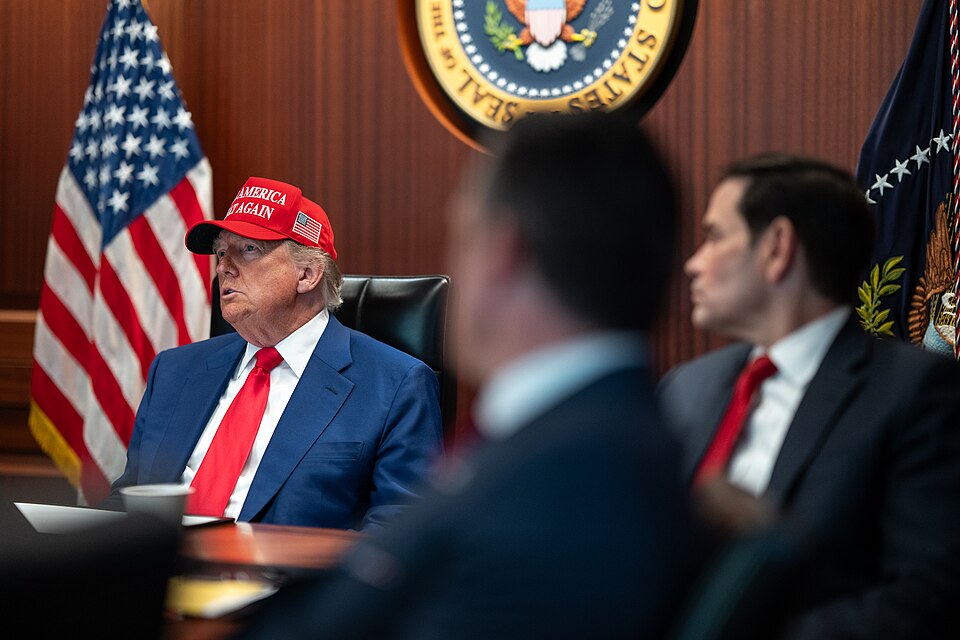
Here’s what Trump had to say.
President Donald Trump is urging Republican governors to think twice before putting the brakes on one of America’s fastest-growing industries, warning that states could miss out on major economic opportunities as the United States competes with China for technological dominance.
Trump made the case for expanding data centers during an interview published Friday, arguing that the massive facilities needed to support artificial intelligence, cloud computing and other advanced technologies could generate significant investment and tax revenue for American communities.
His comments come as state and local leaders across the country debate the benefits and potential costs of rapidly expanding data center construction.
Texas has emerged as a major part of that debate.
Trump told Punchbowl News that he believes Texas is moving in the wrong direction by pushing back against data center development.
While Trump emphasized that he was not formally taking a position on individual state policies, he made it clear that he believes governors should carefully consider the economic consequences of turning these projects away.
“I’m not taking positions,” Trump said. “I just think it’s a mistake because there are other communities that want it.”
According to the president, communities willing to welcome data center investment could receive an enormous economic boost.
“When a community wants it, it means a lot of money is going to come into that community,” Trump added.
Texas Governor Greg Abbott Pumps The Brakes
Trump appeared to be responding to a recent move by Republican Texas Gov. Greg Abbott, who announced a moratorium involving data centers while regulatory agencies examine their impact on the state’s electricity system.
Abbott has made clear that his priority is protecting Texas residents and maintaining a reliable power grid.
“Our top priority is to protect Texans’ safety and quality of life,” Abbott said when announcing the decision.
The governor said data center projects must comply with requirements established by Texas law, the Public Utility Commission of Texas and the Electric Reliability Council of Texas.
Projects that fail to meet those standards, Abbott argued, should not be permitted to connect to the state’s electrical grid.
“Simply put, Texans must come first,” Abbott said.
The disagreement highlights a growing challenge for Republican leaders.
Data centers can attract enormous amounts of private investment, but the facilities can also require tremendous amounts of electricity. That has prompted concerns about whether power generation and transmission infrastructure can expand quickly enough to meet growing demand without creating additional pressure on households and businesses.
Trump Sees A Major Economic Opportunity
Trump believes the economic advantages are too important for governors to ignore.
The president said that if he were running a state, attracting data centers would be one of his priorities.
Trump predicted that the facilities could provide state and local governments with a substantial new source of revenue.
“Taxes are going to go way down because this is a tremendous source of income,” Trump said.
The president’s argument centers on the enormous amounts of money technology companies are investing in infrastructure as artificial intelligence becomes increasingly important to the American economy.
New data center projects can bring construction activity, property investment and additional revenue to communities. Supporters also argue that expanding America’s computing infrastructure is essential if the country intends to remain a global technology leader.
Trump believes Texas, in particular, could benefit enormously.
“For Texas to say no to data centers is a mistake in the sense that it could be bigger than oil,” Trump said.
That is a striking comparison for a state whose economy has been closely connected to the oil and natural gas industries for generations.
Trump’s remarks suggest he sees artificial intelligence and the infrastructure supporting it as potentially transformational for the American economy.
Trump Pushes Back On Data Center Criticism
Economic concerns are not the only objections being raised as data centers spread across the country.
Some communities have questioned how the facilities could affect electricity supplies, water resources, local infrastructure, land development and surrounding neighborhoods.
There have also been complaints about the appearance of the enormous buildings.
Trump rejected that particular criticism.
“I don’t think they’re unsightly,” the president said.
Trump said some of the data center facilities he has seen rank among the most impressive buildings he has encountered.
But for the president, their appearance is secondary to their economic and strategic importance.
“They are tremendously important for the economics,” Trump said.
Trump Says America Cannot Let China Win
Trump also framed the data center debate as part of America’s larger competition with China.
Artificial intelligence is rapidly becoming an important economic and national security issue, and both countries are investing heavily in the infrastructure necessary to support increasingly powerful computing systems.
Trump warned that the United States cannot allow China to gain the upper hand.
“We can’t let China beat us at this,” the president said.
Trump also mentioned claims that China could be connected to efforts opposing data center development in the United States.
“You know, a lot of people think that the campaign that’s being put on is being paid for by China,” Trump said.
The president did not provide evidence demonstrating that Beijing is financing such opposition, making the claim an allegation rather than an established fact.
Trump said he expects to discuss data centers with Chinese President Xi Jinping during a planned state visit in September.
“But I don’t blame him. I mean, we do things and they do things,” Trump said.
Trump Administration Targets Chinese Technology
The president’s comments come as his administration reportedly considers additional restrictions on Chinese technology connected to American data centers.
Reuters reported earlier this week that the Trump administration is preparing a potential ban on imports of Chinese optical transceivers used in data centers.
The restrictions could reportedly be implemented before the end of the year.
Such a move would fit with Trump’s broader effort to reduce American dependence on Chinese technology while encouraging more investment and production tied to the United States.
The administration has repeatedly argued that America must protect critical industries and supply chains from excessive reliance on foreign competitors, particularly China.
Data Centers Become A Growing Political Issue
Data centers are quickly becoming a political issue that crosses traditional party lines.
Republican and Democratic officials alike are facing pressure to balance economic development with concerns from residents about electricity costs, power reliability, water consumption and local development.
For older Americans and retirees living on fixed incomes, the debate over electricity demand may be particularly important. Families want to know that attracting billions of dollars in new investment will not come at the expense of reliable and affordable utility service.
Businesses have similar concerns.
At the same time, state leaders must consider what could happen if they reject projects that neighboring states are willing to accept.
Trump’s argument is that America is entering a new economic era in which computing power and artificial intelligence infrastructure could become increasingly valuable.
Governors who make it too difficult to build those facilities could potentially watch billions of dollars in investment move elsewhere.
Republican Governors Face A Difficult Choice
The disagreement between Trump and Abbott demonstrates the balancing act facing Republican governors.
Abbott is emphasizing electricity reliability, regulatory oversight and the interests of Texas residents.
Trump is emphasizing economic growth, American technological leadership and competition with China.
Those positions are not necessarily incompatible, but they demonstrate the difficult decisions states will face as data center construction accelerates.
Governors must determine how much development their electrical grids can safely handle while also deciding whether additional regulations could discourage investment.
Trump clearly believes the greater danger is allowing America to fall behind.
His message to Republican governors is straightforward: Data centers could represent a major source of future economic growth, and states should be cautious about closing the door on that opportunity.
Whether governors follow Trump’s advice remains to be seen.
But with artificial intelligence investment accelerating and competition with China remaining a major national concern, the battle over America’s data centers is likely only beginning.