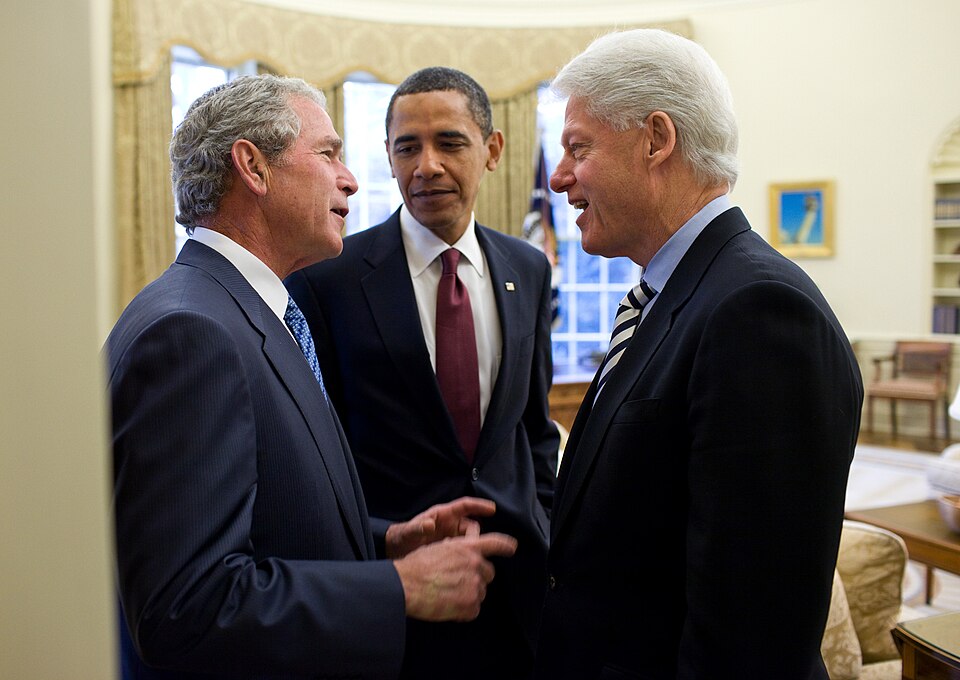
This was a strange move by our former presidents.
Former Presidents George W. Bush, Bill Clinton and Barack Obama are taking a fresh look at America’s presidential history — and some of their observations are getting attention because of how closely they echo political debates surrounding President Donald Trump.
None of the three former presidents directly attacks Trump in the essays. In fact, the historical project they participated in was specifically designed to avoid partisan political commentary.
But the subjects they chose — and the lessons they emphasized — touch on some of the biggest political questions facing Washington today.
Presidential power. Constitutional limits. Political loyalty. The peaceful transfer of power. And the responsibility presidents have to protect American institutions.
That has left plenty of room for readers to draw their own conclusions.
Former Presidents Join Major American History Project
Bush, Clinton and Obama are among the high-profile contributors to In Pursuit, a project commemorating America’s 250th anniversary.
The series brings together former presidents, political figures, historians and other prominent Americans to examine the leadership and legacy of past presidents and first ladies.
Former U.S. Archivist Colleen Shogan is overseeing the project.
Shogan was removed from her government position by Trump in February 2025, adding another interesting layer to her involvement in a series that occasionally touches on issues surrounding presidential authority.
Despite that history, Shogan said contributors were encouraged to avoid partisan and ideological arguments.
The purpose, she explained, is to examine the successes and failures of America’s past and consider what lessons they might offer the country today.
The project covers 43 former presidents and 30 first ladies, with essays being released throughout the year.
Trump and former President Joe Biden are not included because organizers determined their presidencies are still too recent for the type of historical evaluation the project is attempting.
That decision also keeps the project’s two most politically divisive modern presidents largely outside the spotlight.
But not necessarily outside the conversation.
George W. Bush Praises Washington for Giving Up Power
Perhaps the most politically interesting contribution comes from former Republican President George W. Bush.
Bush was assigned another George — America’s first president, George Washington.
His essay places considerable emphasis on Washington’s willingness to surrender power voluntarily.
Washington famously relinquished command of the Continental Army following the Revolutionary War rather than attempting to convert his enormous popularity and military authority into permanent political control.
He later established another historic precedent by leaving the presidency after two terms.
The Constitution did not impose a two-term presidential limit at the time. That restriction came much later with the 22nd Amendment.
Washington simply chose to walk away.
Bush presents that decision as one of Washington’s defining contributions to the American political system.
The nation’s first president had opportunities to retain extraordinary influence, Bush argues, but understood that America’s new constitutional republic required leaders who recognized limits on their own authority.
Bush does not mention Trump anywhere in that argument.
Even so, the subject inevitably carries modern political implications.
Bush Essay Comes Amid Debate Over Trump
Trump’s political opponents have spent years criticizing his response to the disputed 2020 election and his efforts to challenge the outcome.
Trump and his supporters, meanwhile, have long maintained that he had legitimate concerns about how the election was conducted and had the right to pursue legal challenges.
Trump ultimately left the White House in January 2021 and later accomplished something unprecedented in modern American politics: He returned to win the presidency again.
His political comeback made him only the second president in American history, after Grover Cleveland, to win two nonconsecutive terms.
Trump has also periodically joked about or discussed the possibility of remaining president beyond his current term.
The Constitution’s 22nd Amendment prevents a person from being elected president more than twice, making another Trump election constitutionally prohibited under the amendment’s language.
That makes Bush’s decision to emphasize Washington’s voluntary surrender of power especially noteworthy, even though the former president never explicitly connects the lesson to Trump.
Readers are left to determine whether the comparison is intentional.
Another Essay Focuses on “Law Over Loyalty”
Retired Gen. Stanley McChrystal contributed another essay attracting attention for its relevance to modern Washington.
McChrystal examined Ulysses S. Grant, the Union general who helped secure victory in the Civil War before becoming the 18th president.
His essay emphasizes Grant’s commitment to principles larger than individual political ambitions.
Of particular importance was Grant’s resistance to the idea that military leaders should become personally loyal to individual politicians rather than the Constitution and the country.
McChrystal argues that the temptation for political leaders to use government institutions to increase their personal authority is hardly unique to one period of American history.
The lesson carries obvious relevance today.
Trump has repeatedly stressed the importance of having administration officials who will faithfully implement the agenda voters elected him to pursue.
Supporters argue that presidents need officials willing to carry out their policies rather than unelected bureaucrats attempting to obstruct them from inside the federal government.
Critics worry that expectations of political loyalty can go too far when government officials have separate legal and constitutional responsibilities.
It is a disagreement that reaches far beyond Trump and raises a fundamental question about presidential authority.
Where should loyalty to an elected president end and independent institutional responsibility begin?
American presidents have wrestled with variations of that question for generations.
Bill Clinton Looks Back at Theodore Roosevelt
Former Democratic President Bill Clinton chose Republican President Theodore Roosevelt for his contribution.
Clinton focuses partly on Roosevelt’s efforts to confront concentrated corporate power and broaden economic opportunity for ordinary Americans.
Roosevelt developed a reputation as a reformer willing to challenge some of the country’s largest business interests while using the presidency as what he famously regarded as a “bully pulpit.”
But Clinton’s assessment does not simply celebrate Roosevelt.
It also addresses controversial portions of his record, including Roosevelt’s views concerning Black and Indigenous Americans.
That approach reflects one of the broader themes running through the project: Presidents can be recognized for major achievements while still being scrutinized for their failures.
Trump Has Pushed for a More Patriotic View of History
That historical approach arrives amid a broader national debate about how America’s past should be presented.
Trump has pushed federal cultural institutions toward a more patriotic interpretation of American history, arguing that Americans should learn about the extraordinary people and achievements that built the country.
Many conservatives have welcomed that approach.
They argue that schools, museums and cultural institutions have sometimes concentrated so heavily on America’s historical failures that younger generations are given an unnecessarily negative impression of their own country.
Others argue that acknowledging America’s failures is necessary for understanding its successes and progress.
The debate has become another dividing line in the nation’s culture wars.
Yet those two approaches do not necessarily have to be mutually exclusive.
America’s history contains extraordinary accomplishments as well as serious mistakes. Understanding both can provide a more complete picture of how the United States became the country it is today.
Obama Chooses Abraham Lincoln
Barack Obama selected one of the Republican Party’s greatest historical figures for his contribution: Abraham Lincoln.
Lincoln’s presidency offers no shortage of lessons about executive authority, constitutional government and national unity.
He led the United States through the Civil War, preserved the Union and issued the Emancipation Proclamation before his assassination in 1865.
Obama is hardly the only famous political figure participating.
Chief Justice John Roberts writes about William Howard Taft, the only person in American history to serve as both president and chief justice of the United States.
Former Secretary of State Hillary Clinton examines Eleanor Roosevelt.
Former first lady Michelle Obama focuses on Jacqueline Kennedy.
Republican strategist Karl Rove examines William McKinley, while documentary filmmaker Ken Burns writes about Franklin D. Roosevelt.
Presidential historian Michael Beschloss tackles Lyndon B. Johnson.
The wide range of contributors helps prevent the series from becoming exclusively Democratic or Republican.
Trump’s Firing of Archivist Adds Another Political Twist
Shogan’s involvement also gives the project an unmistakable connection to the current administration.
Trump removed Shogan as archivist of the United States in February 2025.
Shogan has said she was not given an explanation for the decision.
She has maintained that the position of national archivist traditionally operates in a nonpartisan fashion, similar to leadership positions at other major American cultural institutions.
The National Archives has an enormously important responsibility.
It preserves federal government records ranging from ordinary administrative documents to some of the most historically significant materials produced by the United States government.
Trump also has a complicated history with the National Archives.
The agency became involved in the dispute over presidential records following Trump’s first term, eventually notifying the Justice Department about the handling of documents removed from the White House.
Importantly, Shogan was not leading the National Archives when that controversy began.
Americans Are Showing Interest in the Series
Despite America’s highly polarized political environment, the project appears to have found a substantial audience.
According to Shogan, the essays have collectively generated more than one million views on Substack.
The accompanying In Pursuit podcast recorded approximately 160,000 audio downloads, while related YouTube videos generated nearly 64,000 views at the time those figures were reported.
A documentary connected with the project is scheduled to air on PBS in October.
Those numbers suggest that plenty of Americans remain interested in presidential history beyond the daily political battles dominating cable television and social media.
Forgotten Presidents Get Another Look
The project is not limited to political giants such as Washington, Lincoln and Roosevelt.
Some of America’s less celebrated presidents receive attention as well.
Former New York congressman Steve Israel examines Millard Fillmore, whose lack of lasting public recognition has practically become his most recognizable characteristic.
Historian David W. Blight examines Franklin Pierce, the Democratic president whose administration came during the escalating national crisis over slavery that ultimately preceded the Civil War.
Pierce won the presidency in 1852 against Whig candidate Gen. Winfield Scott.
That election also serves as a reminder that vicious political attacks existed long before television, talk radio or social media.
Americans may sometimes believe today’s political climate is uniquely hostile.
History suggests otherwise.
The Bigger Question for Trump and Future Presidents
The most interesting element of the project may be how easily Americans can connect historical lessons to current political debates without the authors ever mentioning Trump.
Bush can write about Washington surrendering power.
McChrystal can discuss constitutional loyalty.
Clinton can examine the strengths and weaknesses of Theodore Roosevelt.
Obama can revisit Abraham Lincoln.
None of those subjects requires a direct attack on the current president.
Yet Americans living through another fiercely contested political era will naturally compare today’s leaders with those who came before them.
For conservative readers, there is another important point worth remembering.
Many of the principles being celebrated throughout these essays were demonstrated by Republican presidents.
Lincoln defended the Union. Grant fought to preserve constitutional government after the Civil War. Theodore Roosevelt challenged entrenched interests. Washington, though he governed before the modern party system developed, established presidential traditions that shaped every administration that followed.
Trump’s presidency will eventually receive the same historical treatment.
Supporters will point to his political comeback, immigration policies, economic agenda, reshaping of the Republican Party and willingness to challenge Washington’s political establishment.
Critics will emphasize controversies surrounding his use of presidential power and his confrontational approach to America’s political institutions.
But history rarely delivers its final judgment while a president is still occupying the Oval Office.
That judgment develops over decades.
For now, Bush, Clinton and Obama are looking backward at America’s former leaders.
Whether they are also sending a subtle message about the man currently sitting in the White House is something readers can decide for themselves.