House Republicans are signaling that a new crackdown on government waste may be coming — and several Democrat-run states could soon find themselves under the microscope.
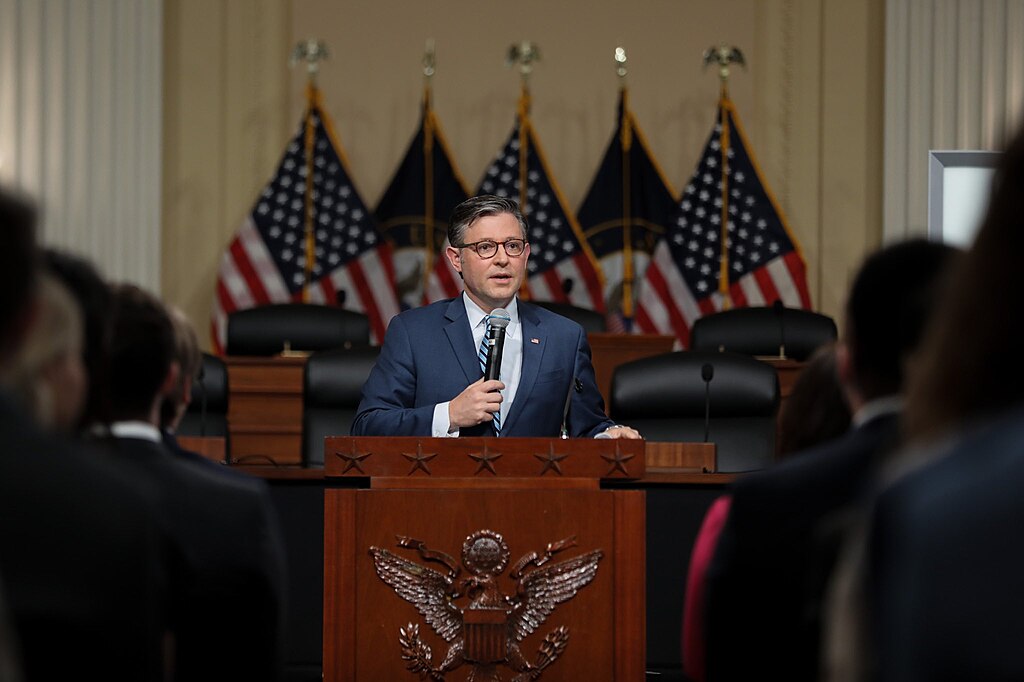
During a news conference at the House Republican retreat in Doral, Florida, House Speaker Mike Johnson (R-La.) suggested lawmakers are exploring a sweeping spending reform package aimed at exposing fraud, waste, and abuse in government programs.
The proposal could target questionable spending practices in states where federal funds support large social service programs.
For many Republicans, the goal is simple: protect taxpayer dollars and restore accountability in government spending.
Republicans Target Waste and Fraud in Government Programs
Speaker Johnson said Republicans are looking for areas where the GOP conference can unite behind reforms that lower costs and eliminate financial mismanagement.
“I’ve always been a strong supporter of reconciliation as an important tool Congress can use,” Johnson said during the briefing.
He explained that Republicans are working to identify policy priorities that most members of the party can support — particularly measures that focus on reducing government waste and improving oversight.
Johnson also pointed to recent investigations into spending irregularities in several Democratic-led states.
“Americans are seeing examples of fraud and abuse coming to light,” Johnson said. “Some of these large blue states have serious problems, and Congress has a responsibility to address that.”
Minnesota Fraud Scandal Draws National Attention
One case receiving significant attention involves a massive fraud scandal in Minnesota’s social services programs.
Last week, Republicans on the House Oversight and Government Reform Committee questioned Minnesota Governor Tim Walz and Attorney General Keith Ellison about the scandal.
Lawmakers say the case represents one of the largest public-fund fraud schemes uncovered in recent years, raising major questions about how taxpayer money was handled.
The issue has become a major political flashpoint in Washington.
President Donald Trump has repeatedly highlighted the case while pushing for stronger immigration enforcement and tighter oversight of government programs.
During his recent State of the Union address, Trump announced what he described as a broader “war on fraud” aimed at protecting American taxpayers.
Budget Reconciliation Could Be the Key
To pass reforms, Republican leaders are considering using budget reconciliation, a legislative process that allows certain tax and spending measures to pass the Senate with a simple majority vote.
Normally, most legislation requires 60 votes in the Senate to overcome a filibuster.
But reconciliation allows the majority party to pass fiscal legislation with fewer votes — making it one of the most powerful tools available in Congress.
Because of this, reconciliation bills are often used to push through major economic reforms.
A Difficult Path in the House
Even with reconciliation, however, passing another spending package will not be easy.
House Republicans currently hold a very narrow majority, meaning party leaders must keep nearly every Republican lawmaker unified to pass major legislation.
Speaker Johnson acknowledged Democrats are unlikely to support the effort.
“My guess is Democrats are not going to help us on that,” Johnson said. “Some of these reforms may have to be pursued as Republican priorities.”
GOP Leaders Say Another Budget Bill Will Be Challenging
Rep. Jason Smith (R-Mo.), chairman of the powerful House Ways and Means Committee, also cautioned that passing a second reconciliation bill would be extremely difficult.
Speaking on CNBC’s Squawk Box, Smith said the first reconciliation package required intense negotiations among Republicans.
“In that first one, we had to thread a needle like you could not imagine,” Smith explained.
Balancing the priorities of different lawmakers, he said, requires careful planning and cooperation within the party.
Government Spending Oversight Likely to Remain a Major Issue
Despite the challenges, Republican leaders appear determined to continue focusing on government accountability, spending oversight, and protection of taxpayer funds.
If another reconciliation bill moves forward, it could trigger a major debate in Washington over how federal money is used by states and local governments.
For many lawmakers, the issue goes beyond politics.
It’s about ensuring that hard-earned taxpayer dollars are spent responsibly — and that fraud and abuse are exposed wherever they occur.