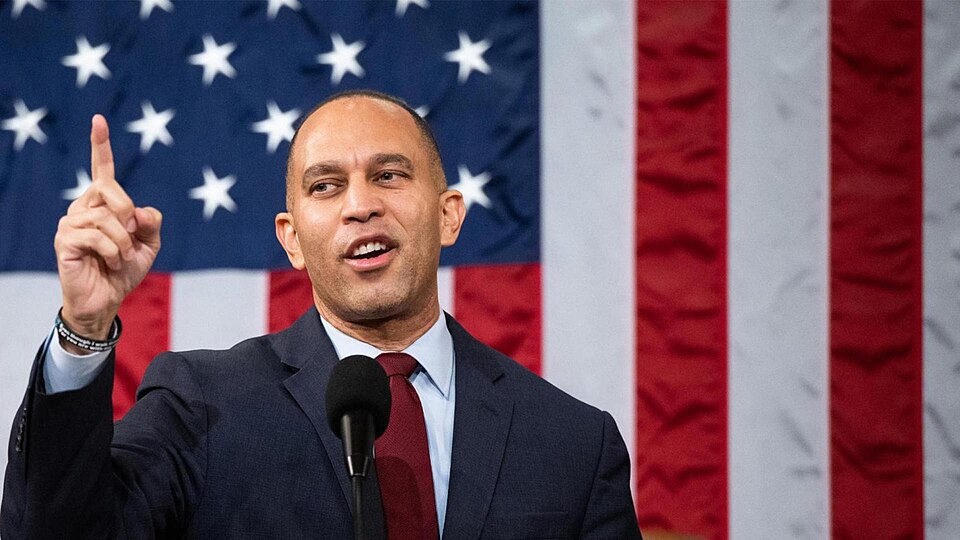
Here’s what Jeffries wants.
House Democratic Leader Hakeem Jeffries is demanding an urgent explanation from President Donald Trump’s administration after a series of major technology outages raised fresh concerns about America’s national security, transportation systems, and critical infrastructure.
The New York Democrat wants senior administration officials to appear before Congress and explain why several important American systems experienced disruptions within days of one another.
Among the incidents drawing attention are a nationwide aviation shutdown, problems affecting major banking services, a Microsoft email outage, and disruptions involving a classified communications network at the National Security Agency.
Although federal officials have identified technical explanations for some of the problems, Jeffries believes Congress needs more information before ruling out other possibilities.
The growing controversy is also raising questions about government spending, infrastructure modernization, and whether Washington is doing enough to protect systems millions of Americans rely upon every day.
Jeffries Demands Answers From Trump’s Administration
During a Tuesday news conference on Capitol Hill, Jeffries expressed concern over the recent disruptions and called for immediate congressional briefings.
He acknowledged that the problems could be connected to aging infrastructure but questioned whether investigators had completely ruled out malicious activity.
Jeffries wants the administration to provide classified information to the Gang of Eight, a bipartisan group of senior congressional leaders and intelligence committee officials.
He also believes lawmakers from both political parties should receive additional briefings about the incidents.
The Democratic leader has already discussed the aviation problems with Transportation Secretary Sean Duffy. However, he indicated that important questions remain unanswered.
His concerns center on what caused the disruptions, whether any incidents were connected, and what additional steps might be necessary to prevent similar failures.
Despite the heightened attention, there is currently no established evidence that the various outages were part of a coordinated cyberattack.
Nationwide Aviation Shutdown Raises Serious Concerns
One of the most significant disruptions occurred Friday when the Federal Aviation Administration temporarily grounded flights across the United States.
The unexpected shutdown affected air travel nationwide and highlighted weaknesses in the technology responsible for managing American aviation.
Federal officials subsequently traced the disruption to a recently installed network router in Arkansas.
Following that discovery, the FAA suspended additional installations of the affected equipment while technicians continued investigating the problem.
The agency also disabled previously installed routers of the same type as a precaution.
The incident has renewed longstanding concerns about the country’s aging air traffic control infrastructure.
For travelers, including retirees, business owners, and families, the disruption served as a reminder of how dependent modern transportation has become on reliable technology.
Even temporary problems can interfere with travel plans, create financial losses, and undermine public confidence in essential services.
The Trump administration is now facing pressure to demonstrate that federal agencies can prevent similar disruptions in the future.
Trump Administration Pushes $50 Billion Infrastructure Plan
Transportation Secretary Sean Duffy has argued that outdated aviation infrastructure is a major problem requiring substantial federal investment.
The administration is seeking approximately $50 billion to modernize the nation’s air traffic control system.
Duffy has suggested that years of inadequate investment contributed to the vulnerabilities exposed by the recent aviation problems.
The proposed improvements would focus on upgrading the technology and equipment responsible for keeping American airspace operating safely and efficiently.
However, the massive funding request is already generating questions on Capitol Hill.
Congress previously approved more than $12 billion for aviation modernization through legislation signed by President Trump in 2025.
Some lawmakers are now questioning why significantly more funding is necessary and whether previously approved resources have been used effectively.
The debate is especially important for Americans concerned about rising federal spending, government waste, and the national debt.
Modernizing essential infrastructure remains a priority, but lawmakers must also determine whether additional taxpayer dollars will produce meaningful improvements.
Democrats Question Additional Federal Spending
Jeffries has declined to commit to supporting the administration’s entire $50 billion proposal.
Instead, he has emphasized the importance of reviewing the spending plan and ensuring federal resources are distributed appropriately.
He indicated that senior Democratic lawmakers responsible for transportation policy and congressional appropriations would play important roles in evaluating the request.
The issue presents Congress with a difficult decision.
On one hand, aging transportation technology can create serious safety concerns and economic disruptions.
On the other, committing billions of additional taxpayer dollars without adequate oversight could raise concerns about government efficiency and fiscal responsibility.
Those questions extend beyond partisan politics.
Republicans and Democrats alike have an interest in ensuring that essential federal systems operate reliably without unnecessary spending.
The administration will likely face continued scrutiny as lawmakers examine whether additional investments are justified.
National Security Concerns Add To Growing Pressure
The aviation incident was not the only technological disruption attracting attention.
Recent problems involving Microsoft Outlook, financial institutions, and a classified National Security Agency communications network have also generated questions.
The NSA disruption was particularly sensitive because the agency handles some of the nation’s most important intelligence and communications responsibilities.
Officials have attributed that incident to routine maintenance and indicated that essential mission capabilities remained operational.
Federal intelligence officials have also suggested that the broader series of technology problems is more consistent with technical issues and system upgrades than a coordinated cyberattack.
Nevertheless, the close timing of several disruptions has intensified public attention.
Jeffries argues that congressional leaders should receive additional information to understand the risks and evaluate whether any changes are necessary.
Importantly, officials have not established a common cause connecting all the recent incidents.
That distinction matters because simultaneous technology problems do not automatically indicate foreign interference or deliberate sabotage.
Americans Want Accountability And Reliable Government Services
Beyond the political disagreements, the controversy highlights an issue affecting Americans across the country.
Modern life depends heavily on interconnected technology.
Airports rely on sophisticated communications equipment to direct aircraft safely. Financial institutions use complex computer networks to process transactions. Federal intelligence agencies depend on secure systems to protect sensitive information.
When those systems experience disruptions, the consequences can spread quickly.
The incidents have also renewed debate about whether federal agencies are maintaining the infrastructure they already possess.
For taxpayers, the question is not simply whether Washington should spend more money.
It is whether existing federal resources are being managed responsibly and whether new investments will deliver measurable results.
The Trump administration has made infrastructure improvements a central part of its response to the aviation problems.
Jeffries, meanwhile, is demanding additional transparency before Congress moves forward with major decisions.
Both sides face pressure to demonstrate that their proposals will improve reliability and protect the public.
What Happens Next For Trump And Congress?
The immediate question is whether the Trump administration will provide the comprehensive congressional briefings Jeffries is requesting.
Those discussions could help lawmakers determine whether the recent incidents represent separate technical failures or reveal broader weaknesses requiring federal attention.
Congress must also consider the administration’s proposed aviation modernization funding.
Additional hearings, oversight reviews, and negotiations could influence how much money ultimately becomes available for infrastructure improvements.
Meanwhile, federal agencies continue examining the disruptions and taking steps to prevent future problems.
Although the political debate is intensifying, investigators have not established that the outages were connected to a coordinated attack.
For now, the focus remains on identifying technical vulnerabilities, restoring public confidence, and determining whether additional safeguards are necessary.
The larger question facing Washington is whether federal officials can strengthen America’s essential infrastructure while protecting taxpayers from unnecessary government spending.
As Jeffries presses the Trump administration for answers, Americans will be watching to see whether Congress can move beyond political disagreements and deliver practical solutions that improve national security, transportation reliability, and government accountability.