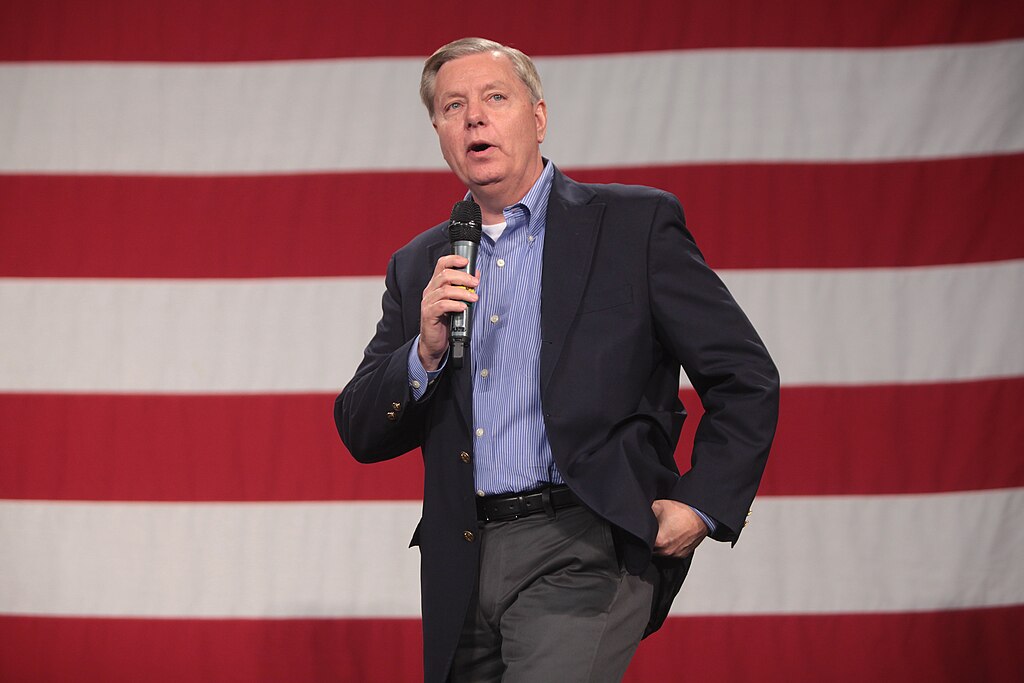
Here’s what was said.
Former New Jersey Governor Chris Christie is once again fueling Republican infighting, claiming that several GOP lawmakers who publicly praise President Donald Trump privately say something very different behind closed doors. Among those Christie accused of quiet disloyalty was longtime Trump ally Lindsey Graham.
During an appearance on Overtime with Bill Maher, Christie alleged that Republican officials regularly thank him in private for openly criticizing Trump, while continuing to offer glowing public endorsements of the president when cameras are rolling.
According to Christie, these lawmakers privately agree with harsh assessments of Trump’s leadership but feel pressured to project unwavering loyalty in public to protect their political standing.
When pressed by host Bill Maher to identify specific names, Christie pointed directly to Graham, suggesting the senator’s tone shifted after developing a close personal relationship with Trump.
Christie referenced Graham’s past criticism of Trump during the 2016 presidential race, implying that the senator’s later loyalty coincided with social access and proximity to power rather than principle.
Graham’s office swiftly pushed back, calling Christie’s claims false and misleading. In a statement to The Hill, a spokesperson accused Christie of attempting to manufacture division between Trump and his allies for political relevance.
The statement emphasized that Graham’s public record, votes, and actions consistently demonstrate his support for Trump and the conservative agenda. Graham remains a frequent presence alongside the president and recently attended Trump’s Super Bowl watch party.
Christie, once a close Trump ally himself, has grown increasingly hostile toward the president in recent years. During the 2024 Republican primary, Christie positioned himself as one of Trump’s most outspoken GOP critics, frequently attacking Trump over his response to the 2020 election.
Christie has claimed his break with Trump became permanent after the president continued to question the legitimacy of the election results, a stance Christie said he could not support.
In recent months, Christie has also warned that Republicans could face serious political consequences if Trump fails to expand his appeal beyond core supporters. He has argued that rallies and messaging alone will not address the economic and cultural concerns of everyday Americans.
The controversy highlights a deeper divide within the Republican Party—one that many conservative voters say reflects long-standing hypocrisy among Washington insiders.
Former Georgia Rep. Marjorie Taylor Greene has also suggested that some Republicans privately mock Trump while publicly praising him, reinforcing concerns that parts of the GOP establishment are disconnected from the voters who fueled Trump’s rise.
For many conservatives, Christie’s remarks underscore a familiar frustration: elected Republicans who campaign as Trump allies while quietly undermining the movement that reshaped the party and energized millions of voters nationwide.