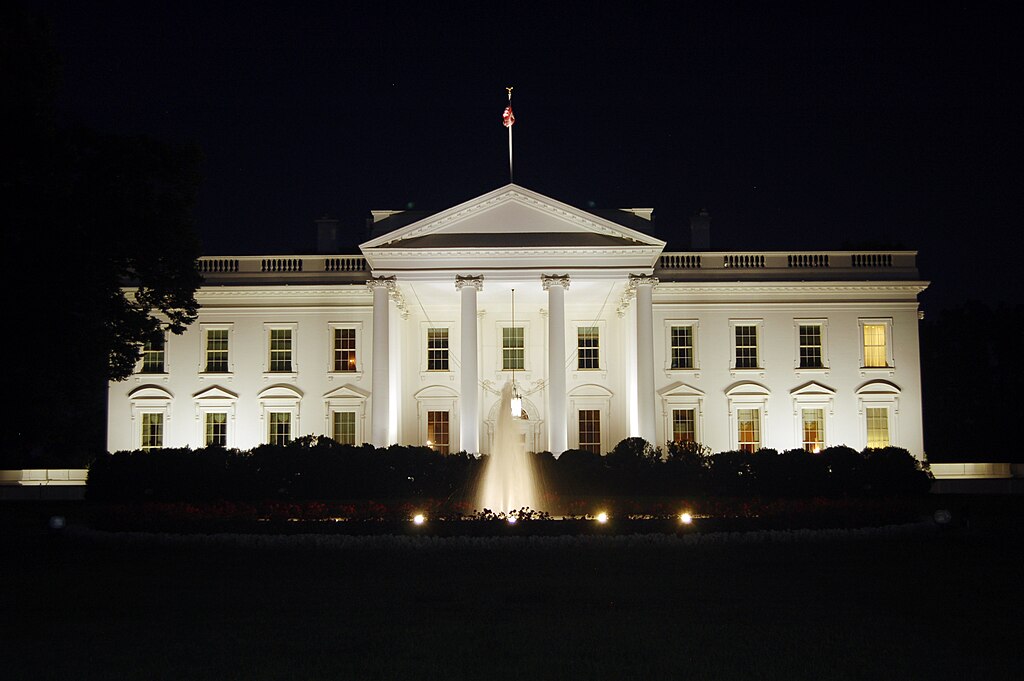
This is interesting.
President Donald Trump revealed Monday that the new White House ballroom under construction will feature advanced security upgrades — including what he described as a “drone-free roof.”
Trump made the remarks during a press conference at his Mar-a-Lago resort in Florida alongside Israeli Prime Minister Benjamin Netanyahu. While discussing economic policy and criticizing Federal Reserve leadership, the president turned his attention to the ambitious ballroom project.
According to Trump, the building is significantly larger and more secure than originally planned, especially after officials determined it could be used for a future presidential inauguration.
“It’s bigger than I originally said,” Trump explained. “Once we realized we may do the inauguration there, everything changed. It has bulletproof glass, and it has what they call a drone-free roof. Drones won’t be able to get near it. It’s a big, beautiful, and very safe building.”
The White House has not yet released detailed specifications on the technology involved, though Trump emphasized the focus on safety and long-term durability.
A Long-Awaited Addition to the White House
Trump is expected to formally present construction plans for the ballroom in January. Such presentations are typically the first step in a review process overseen by the National Capital Planning Commission.
The ballroom project was announced shortly before demolition began on the historic East Wing, a move that immediately drew national attention.
Cost estimates for the project have steadily increased. Early projections placed the ballroom at approximately $250 million, later rising to $300 million. Most recently, Trump estimated the total cost at around $400 million.
“For over 150 years, they wanted a ballroom,” Trump said at a recent White House Hanukkah event. “Now we’re giving it to them — myself and private donors — free of charge. No taxpayer money. A building worth about $400 million.”
Trump has repeatedly stated the project is being funded entirely through private donations, not federal funds.
Timeline, Leadership, and Ongoing Debate
Construction on the ballroom is expected to be completed by 2028. Earlier this year, Trump replaced the project’s lead architect, selecting Shalom Baranes to oversee the design and construction.
As expected, the project has sparked debate. Several former White House occupants and political figures, including members of the Clinton and Obama families, have criticized making major changes to what is often referred to as “The People’s House.”
Opponents argue that the administration moved too quickly without sufficient consultation from oversight bodies such as the National Capital Planning Commission and the Commission of Fine Arts.
Presidential Renovations Are Nothing New
Supporters of the project note that controversy surrounding White House renovations is not new. In the early days of the republic, even President Thomas Jefferson faced criticism after ordering architectural changes to the executive mansion. Newspapers of the era accused Jefferson of displaying “aristocratic tendencies.”
Backers argue Trump’s ballroom finally addresses a long-standing need for a large, secure venue capable of hosting major national and international events — all without placing additional burden on American taxpayers.