Here’s what happened.
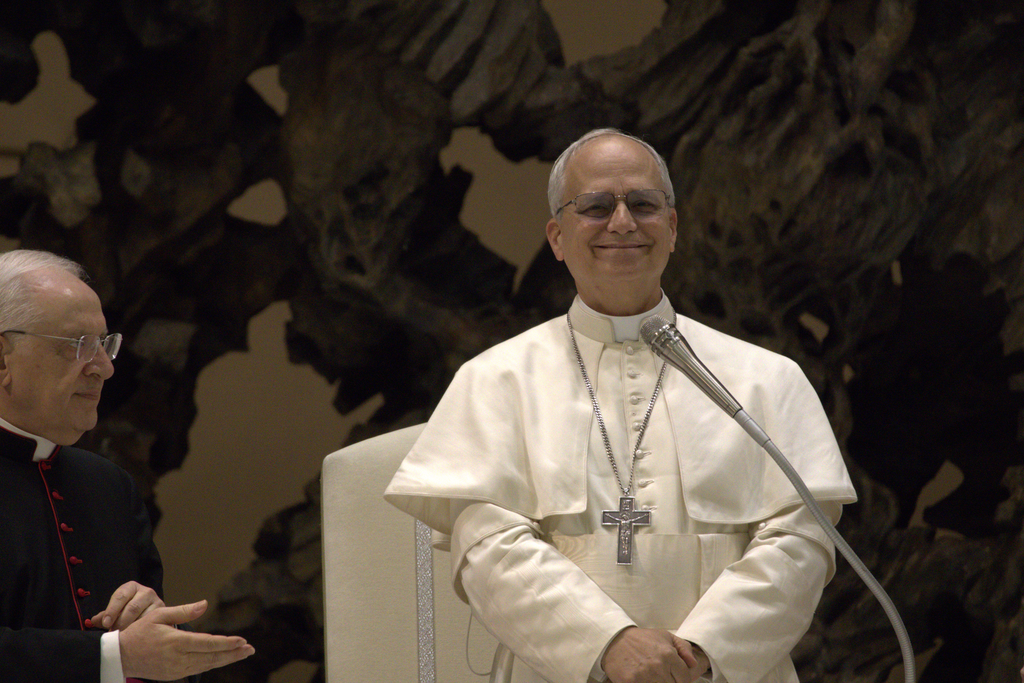
House Speaker Mike Johnson delivered a forceful, Scripture-based defense of border security this week after comments from Pope Leo were cited as criticism of President Donald Trump’s immigration enforcement policies.
The exchange occurred during a Capitol Hill press briefing, when Johnson was asked to respond to the pope’s recent use of biblical passages—specifically Matthew 25—to question large-scale deportations and border enforcement.
Pope Leo has made clear in the past that the Catholic Church does not support unrestricted borders. At the same time, he has consistently called for migrants to be treated with dignity and compassion. In his recent Apostolic Exhortation, Dilexi Te, the pope referenced Matthew 25:31–40 to underscore the Christian duty to care for the vulnerable and those who arrive as strangers.
Johnson said he would offer a more detailed response online later in the day but provided a clear summary during the press conference.
“Borders and walls are biblical,” Johnson said. “From the Old Testament through the New Testament, Scripture recognizes nations, laws, and civil order.”
Johnson emphasized that immigration itself is not condemned in the Bible. He noted that Scripture encourages kindness toward foreigners, but he argued that lawful entry and cultural assimilation are also clearly expected.
“When people enter a nation, they don’t have the authority to rewrite its laws or dismantle its society,” Johnson said. “Assimilation is anticipated in Scripture, and that principle has been largely ignored in recent years.”
The Speaker then drew a distinction between personal Christian charity and the responsibility of government.
“Scripture calls individuals to love their neighbors and care for the sojourner,” Johnson explained. “But civil authorities are given a different responsibility—to maintain order and enforce the law.”
Johnson pointed to Romans 13, which describes governing authorities as servants of God tasked with restraining wrongdoing and preserving social stability.
“Government exists to punish evil and reward good,” Johnson said. “That responsibility has not been properly exercised at our borders.”
Johnson also raised concerns about public safety, citing the rise in crimes associated with illegal border crossings. He argued that protecting citizens is not only a constitutional duty but a biblical one.
“Sovereign borders are good, moral, and just,” Johnson said. “Not because we hate people outside our country, but because we have a duty to protect the people inside it.”
Later that day, Johnson expanded on his remarks in a post on X, explaining that he had been asked to outline the biblical case for immigration enforcement and border security.
In a longer written explanation—originally drafted during the Biden administration—Johnson outlined what he described as four God-ordained spheres of authority: the individual, the family, the church, and civil government.
He noted that Scripture assigns civil government the authority to “bear the sword” and administer justice, citing Romans 13:1–4 and Ecclesiastes 8:11 as warnings against lawlessness and unchecked crime.
Johnson further argued that passages often cited to justify open borders are frequently taken out of context. He said commands found in Leviticus 19 and Matthew 25 were directed at individual believers—not governing institutions.
“When Jesus spoke about caring for ‘the least of these,’ He was speaking to His disciples,” Johnson wrote. “He was not issuing immigration policy to civil authorities.”
Johnson concluded by cautioning against using Scripture selectively to undermine national sovereignty. He said Christianity calls believers to both mercy and justice—and that the two are not in conflict.
According to Johnson, supporting strong border enforcement, lawful immigration, and national sovereignty is fully consistent with biblical teaching and Christian values.