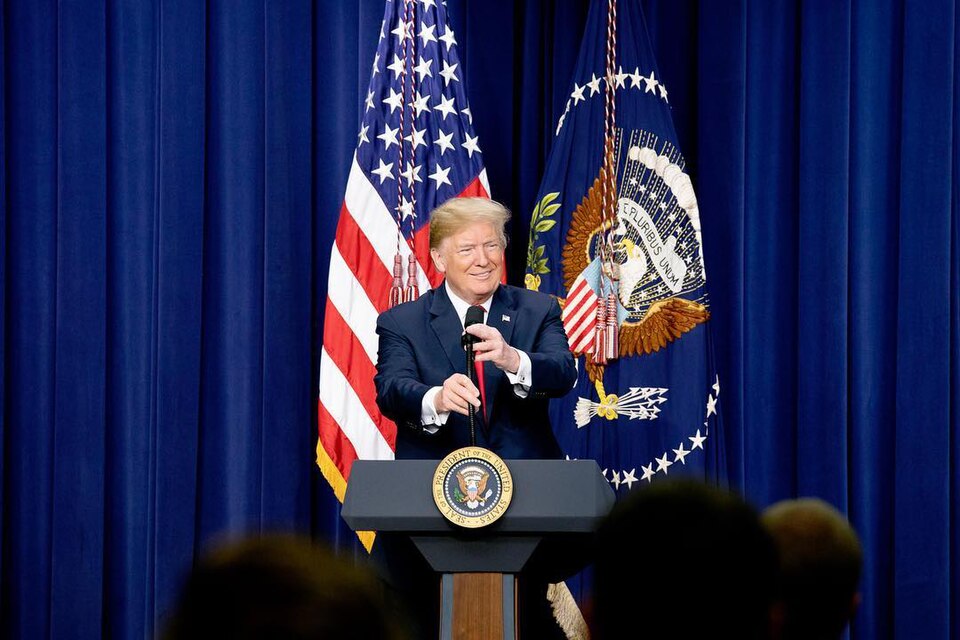
President Donald Trump sparked questions Thursday after making a mysterious comment about a court ruling while discussing the future of American sports.
Speaking at the White House during an event honoring Team USA athletes from the 2026 Winter Olympics and Paralympic Games in Milano Cortina, Italy, Trump praised American competitors before turning his attention to some of the biggest controversies facing sports today.
Among those issues were the future of college athletics and the ongoing national debate over transgender participation in women’s sports.
But it was one particular statement from Trump that quickly stood out.
The president suggested that a judge had effectively ruled against sports themselves — a description that left observers trying to determine exactly which legal decision he was talking about.
“We had a bad judge’s decision,” Trump said, before claiming that a judge who “knew nothing about sports declared sports unconstitutional.”
Trump did not name the judge, identify the court or provide the specific case behind his surprising description.
That omission created an obvious question: What exactly was the president talking about?
Trump Vows to Protect Women’s and College Sports
Before making the mysterious remark, Trump told the assembled athletes that his administration was working to preserve America’s athletic traditions.
“We’re doing everything we can to protect the cherished sporting traditions that have long been part of our nation from the beginning,” Trump said.
The president specifically highlighted his administration’s efforts involving women’s athletics and college sports.
Trump has made the protection of women’s sports a prominent part of his political agenda, repeatedly arguing that biological differences between men and women must remain a consideration in competitive athletics.
The issue has resonated with many conservative voters who believe female athletes should have separate competitive categories and that decades of progress in women’s athletics should be protected.
Trump then shifted to the unexplained court decision.
After criticizing the judge, the president suggested that lawmakers and other officials had responded by developing legislation.
“We had to come and put something together,” Trump said.
He added that a bill was currently being pursued and declared that, if lawmakers approve it, “we’ll be bringing sports back.”
Exactly how that legislation relates to the court decision Trump mentioned was not immediately apparent from his remarks.
What Court Decision Was Trump Talking About?
Trump’s statement attracted attention largely because there is no obvious ruling that literally declared sports unconstitutional.
However, the president’s remarks came amid significant political activity surrounding college athletics and women’s sports.
Republican Sens. Josh Hawley of Missouri, Jim Banks of Indiana and Tommy Tuberville of Alabama unveiled an amendment Thursday related to the proposed Protect College Sports Act.
Their amendment focuses on an issue that has become increasingly important for Republicans: preserving state laws that restrict transgender women from participating in women’s college athletics.
The senators contend that additional protections are necessary to prevent federal college sports legislation from overriding state-level laws governing women’s athletic competition.
Supporters of the broader Protect College Sports Act have described the legislation as an attempt to establish more consistent national standards for college athletics while providing additional rights and protections for student-athletes.
The disagreement highlights a larger question facing Congress: How much authority over college sports should remain with individual states, and how much should be determined by Washington?
Republicans Push for State Protections
Hawley, Banks and Tuberville want to make certain that states can continue enforcing their own laws concerning eligibility for women’s college sports.
For conservatives, the issue extends beyond athletics.
It also involves questions of federalism, state authority, fairness and whether Washington should be able to override policies adopted by elected state governments.
Republicans supporting the amendment are seeking assurances that new federal legislation will not unintentionally eliminate protections already established at the state level.
The timing of the proposal may provide some context for Trump’s comments, although the president did not explicitly connect his mysterious reference to that specific legislative fight.
Without additional clarification from Trump or the White House, identifying the precise court decision behind his remark remains difficult.
Supreme Court Delivered Trump a Major Victory
Trump has already celebrated a significant legal development involving women’s sports.
In June, the U.S. Supreme Court upheld state restrictions affecting transgender participation in girls’ sports in West Virginia and Idaho.
Trump quickly celebrated the decision on Truth Social.
The president characterized the ruling as a major victory for those who believe women’s athletic competitions should remain divided according to biological sex.
The Supreme Court decision represented an important development in a legal and political battle that has spread across the country.
Numerous states have considered or enacted policies governing transgender participation in school and college athletics, while opponents have challenged some of those restrictions in court.
As a result, what once may have appeared to be primarily a local school athletics issue has developed into a national debate involving state legislatures, governors, Congress and the federal courts.
Trump Keeps Women’s Sports in Political Spotlight
Trump has repeatedly positioned himself alongside Republicans seeking stronger protections for women’s athletic categories.
Supporters argue that allowing biological males to compete in female divisions can create competitive disadvantages for women and potentially affect scholarships, records, roster positions and championship opportunities.
Critics of restrictions on transgender athletes argue that transgender students should have opportunities to participate in athletics consistent with their gender identity.
Those competing arguments have helped turn the issue into one of the most closely watched cultural debates surrounding American sports.
Trump has shown little indication that he intends to retreat from the subject.
Instead, his White House remarks suggest that women’s sports and college athletics will continue to receive significant attention from his administration.
College Sports Face Major Changes
The transgender athlete debate is only one part of a much broader transformation taking place across college athletics.
College sports programs are dealing with major questions involving athlete compensation, name-image-and-likeness opportunities, conference realignment, federal regulation, eligibility standards and the relationship between universities and student-athletes.
Congress has consequently faced growing pressure to establish clearer national rules.
Republican lawmakers, however, are warning that any federal solution should not erase laws already approved by individual states, particularly those dealing with women’s athletic competition.
That could make the Protect College Sports Act and proposed amendments to it an important political battle in Washington.
Trump’s Remark Leaves One Big Question
For now, the most intriguing part of Trump’s White House appearance may be the question he did not answer.
Which judge supposedly “declared sports unconstitutional”?
Trump offered no case name or other details that would make the reference immediately identifiable.
It is possible the president was using exaggerated language to characterize a legal setback involving college athletics rather than describing the literal language of a court ruling. Without further clarification, however, the exact meaning of the comment remains uncertain.
What is clear is Trump’s broader position.
The president says his administration is working to protect women’s athletics, preserve college sports and support legislation addressing the rapidly changing legal environment surrounding American competition.
For conservative voters concerned about fairness in women’s sports and the growing federal role in college athletics, the debate is likely to remain important.
And with Republicans in Congress pushing new protections while courts continue considering disputes involving athletic eligibility, Americans may be hearing much more about the issue in the months ahead.