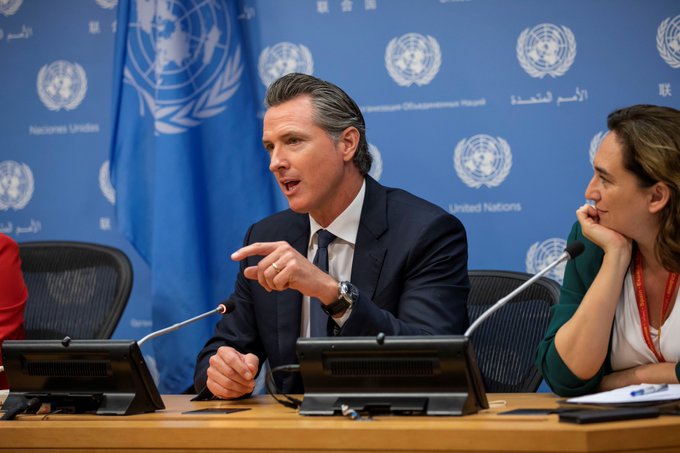
Newsom believes attacking US allies is going get him elected.
California Gov. Gavin Newsom is putting himself squarely in the middle of one of the Democratic Party’s most contentious foreign-policy debates as questions continue to surround his possible political ambitions in 2028.
Newsom said Monday that criticism of Israeli Prime Minister Benjamin Netanyahu and his policies has become widespread throughout the Democratic Party.
The comments provide another indication of how dramatically the political debate over Israel has changed since the Hamas-led Oct. 7, 2023, attack and the subsequent war in Gaza.
They also put additional attention on Newsom, who has frequently been discussed as a potential Democratic presidential contender in 2028.
Newsom Says Democrats Have Turned Against Netanyahu
During an interview with PBS News, host Amna Nawaz asked Newsom about Democratic divisions over Israel.
Newsom argued that the party is overwhelmingly opposed to the policies of Netanyahu’s government.
Newsom said criticism of Netanyahu’s actions has become widespread across the Democratic Party.
At the same time, the California governor emphasized that his criticism of Netanyahu should not be interpreted as opposition to Israel itself.
Newsom said he supports a secure, democratic Israel existing alongside an equally secure and democratic Palestinian state.
He also offered a sharply critical assessment of how the conflict has unfolded, describing the situation as a “moral catastrophe” regardless of the debate surrounding the term genocide.
Israel Has Become a Major Democratic Divide
Newsom’s comments come as Israel policy continues to generate significant disagreements among Democratic politicians and voters.
The issue has increasingly affected Democratic primaries, congressional debates and discussions surrounding America’s long-standing relationship with Israel.
Recent congressional votes illustrate the changing political environment.
In July, 103 House Democrats supported an unsuccessful proposal that would have removed approximately $3.3 billion in military assistance for Israel. Other Democrats joined Republicans in opposing the proposal.
That division demonstrated that although criticism of Netanyahu has grown within Democratic politics, substantial disagreements remain over how the United States should respond.
Newsom’s Position Gets More Attention With 2028 Approaching
Newsom’s statements are receiving additional scrutiny because of speculation that he could eventually seek the Democratic presidential nomination.
The California governor has increasingly participated in national political debates well beyond issues directly affecting his state.
That means his positions on Israel, immigration, the economy and other major national issues are likely to receive greater examination as Democrats consider the party’s future after President Donald Trump leaves office.
Newsom’s latest remarks do not establish that his position on Israel was adopted specifically because of a potential presidential campaign. However, his national ambitions make his comments particularly relevant to the emerging debate over what Democratic candidates could face in 2028.
Newsom Has Previously Defended His Support for Israel
Newsom’s position is complicated by his previous statements about Israel.
In a January discussion with conservative commentator Ben Shapiro, Newsom underscored his longstanding support for Israel.
But Newsom has also become increasingly critical of Netanyahu’s government and Israel’s treatment of Palestinians.
Earlier this year, he drew attention after comparing conditions involving Palestinians to an “apartheid state” and raising questions about whether the United States should reconsider aspects of its relationship with Israel.
Taken together, the comments show Newsom attempting to draw a distinction between support for Israel as a country and opposition to policies pursued by Netanyahu’s government.
AIPAC Money Becomes Another Political Flashpoint
Newsom also addressed another increasingly important issue for Democratic candidates: financial support connected to the American Israel Public Affairs Committee, better known as AIPAC.
Asked whether accepting AIPAC support was becoming a political litmus test, Newsom said opposition to taking such money has become widespread among Democrats.
Newsom has said that he has never accepted money from AIPAC and does not intend to do so in the future.
AIPAC and organizations associated with the pro-Israel political movement have played prominent roles in Democratic congressional primaries, making the subject of campaign spending another part of the party’s larger Israel debate.
Democratic Voters Are Changing Their Views
Polling also suggests that attitudes toward U.S. support for Israel have changed significantly among Democratic voters.
An Associated Press-NORC poll cited in the original reporting found that 58 percent of Democrats believed the United States was supporting Israel too much.
The poll also found that 62 percent of Democrats believed Washington had not provided enough support to Palestinians, up from 49 percent in 2024.
Those numbers help explain why Israel could remain a politically significant issue for Democrats heading into future elections.
But Democratic voters are not necessarily united on what American policy should look like. Questions involving military assistance, Palestinian statehood, Israeli security and America’s broader role in the Middle East continue to produce disagreement.
Newsom Positions Himself in a Changing Democratic Party
Newsom’s comments ultimately highlight a larger political transformation taking place inside the Democratic Party.
For decades, strong American support for Israel enjoyed substantial bipartisan backing in Washington. That consensus has faced growing pressure as Democratic voters and politicians have become increasingly critical of Netanyahu and Israel’s conduct toward Palestinians.
Newsom appears to be placing himself within that changing political environment while maintaining that he remains supportive of Israel itself.
That distinction could become increasingly important if he eventually launches a presidential campaign.
For now, Newsom has not formally become a 2028 presidential candidate. But every major national position he takes will inevitably receive attention through the lens of what could come next.
And his latest comments make one thing clear: Israel is likely to remain one of the major foreign-policy debates facing Democrats as the party begins looking toward its political future.