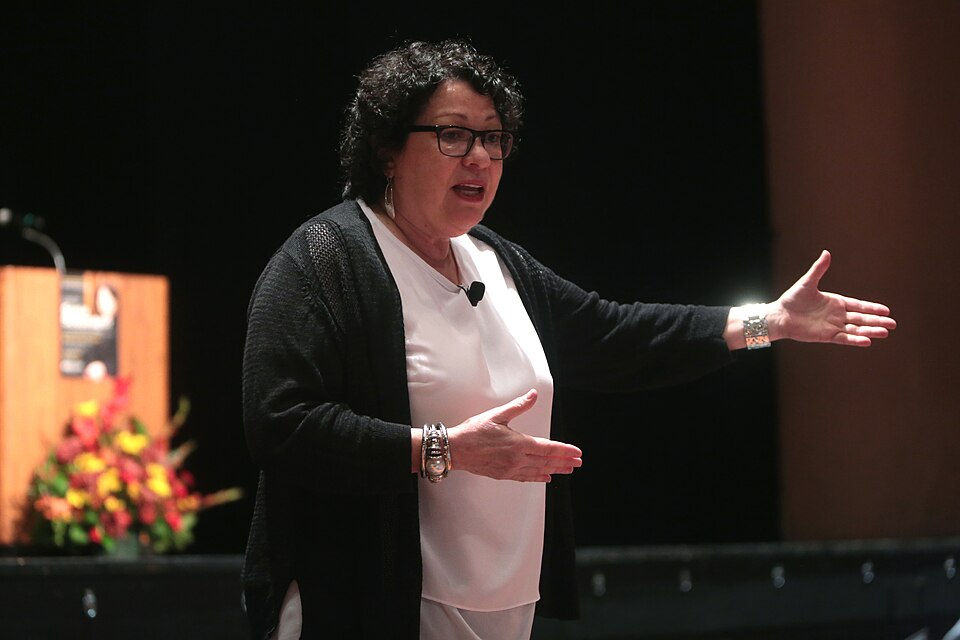
One Justice is clearly unhappy.
Supreme Court Justice Sonia Sotomayor is calling attention to one of President Donald Trump’s biggest legal victories, revealing that she hopes the nation’s highest court will eventually overturn its landmark ruling on presidential immunity.
The liberal justice made her position clear during a public appearance Saturday, November 7, criticizing decisions made by the Supreme Court’s conservative majority and specifically targeting the 2024 ruling that established significant legal protections for presidents.
Her remarks have renewed a major constitutional debate over presidential authority, accountability, and the limits of the judicial system.
Sotomayor Targets Trump’s Supreme Court Victory
Speaking at George Washington’s Mount Vernon estate in Virginia, Sotomayor expressed frustration with several decisions handed down by her colleagues.
The justice, who frequently disagrees with the court’s conservative majority, suggested that certain rulings should eventually be reversed.
She initially made a lighthearted remark about some of the court’s decisions before acknowledging that her concerns were serious.
Sotomayor then identified the controversial presidential immunity case as a decision she hopes will be overturned during her lifetime.
The remarks represent another public expression of her longstanding opposition to the Supreme Court’s July 2024 decision in Trump v. United States.
That ruling was widely considered a major victory for Trump, whose legal team had argued that presidents must receive constitutional protections for actions taken while performing their official duties.
What the Supreme Court Actually Decided
The presidential immunity ruling established important legal protections for current and former presidents.
In a 6-3 decision, the Supreme Court determined that presidents are entitled to absolute immunity from criminal prosecution when exercising certain core constitutional powers.
The justices also ruled that other official presidential actions receive at least presumptive immunity.
However, the court made clear that presidents do not enjoy immunity for unofficial or private conduct.
Chief Justice John Roberts authored the majority opinion, joined by the court’s five other conservative justices.
The ruling centered on the constitutional separation of powers and the need to protect the executive branch from improper interference.
The majority reasoned that presidents must be able to carry out their constitutional responsibilities without constantly worrying that official decisions could later expose them to criminal prosecution.
The case originated from federal criminal proceedings involving Trump’s actions following the 2020 presidential election.
For Trump, the decision established substantial constitutional protections while also creating a legal precedent that applies to future presidents, regardless of political party.
Why Sotomayor Strongly Opposed the Decision
Sotomayor was among the three liberal justices who dissented from the 2024 ruling.
She argued that granting broad presidential immunity could undermine accountability and weaken the principle that government officials remain subject to the law.
Her dissent reflected concerns that certain presidential actions might receive protection even when they raise serious questions about the exercise of executive authority.
The conservative majority reached a different conclusion.
Roberts emphasized that the presidency occupies a unique position under the Constitution and requires protections necessary for the executive branch to function independently.
Supporters of the ruling argue that without such safeguards, former presidents could face politically motivated criminal investigations over decisions made while governing.
Critics believe the protections go too far and could make it more difficult to hold presidents accountable for misconduct involving official responsibilities.
Those competing interpretations remain central to the dispute.
Justice Warns About Changes at the Supreme Court
Sotomayor’s appearance was not limited to criticism of presidential immunity.
During the discussion, she also addressed broader changes in constitutional law and the direction of the nation’s judicial system.
She acknowledged that the country is experiencing significant changes in how established legal principles are interpreted.
The justice suggested that Americans may face a difficult period as the legal system adjusts to those developments.
Her comments came during an event connected to America’s 250th anniversary, where civic education and constitutional responsibilities were major subjects of discussion.
Sotomayor also emphasized the importance of understanding American government and participating in the democratic process.
She serves on the board of iCivics, an organization established by former Supreme Court Justice Sandra Day O’Connor to promote civic education.
Political Climate Adds Attention to Her Remarks
Sotomayor’s comments came just days after the November 2026 midterm elections, which resulted in Democrats gaining control of both chambers of Congress.
During her appearance, the justice briefly addressed voter participation and the importance of Americans exercising their right to vote.
She did not directly connect the election results to her criticism of the presidential immunity decision.
Nevertheless, her remarks arrive during a politically significant period in Washington, with control of Congress changing hands and disagreements over presidential authority continuing.
The Supreme Court’s conservative majority remains an important factor in legal disputes involving the presidency, federal government authority, and constitutional interpretation.
Could Trump’s Presidential Immunity Protections Be Taken Away?
Although Sotomayor has expressed hope that the Supreme Court will eventually reverse its decision, overturning the precedent would require additional legal action.
A future case would need to present the appropriate constitutional questions, and a majority of justices would have to agree that the earlier ruling should be reconsidered or overturned.
That is a substantial obstacle.
The same conservative majority that supported the 2024 decision remains central to the court’s current ideological balance.
Importantly, Sotomayor’s comments do not mean that the Supreme Court has agreed to rehear the Trump case or that presidential immunity protections are about to disappear.
Her statements reflect a personal judicial position rather than an official announcement of new court proceedings.
The ruling also affects far more than Trump.
Any future president, whether Republican or Democrat, could potentially rely on the protections established by the decision when defending official presidential conduct.
That makes the precedent particularly consequential for the long-term balance of power between the executive branch and the federal courts.
A Major Constitutional Question Remains
The disagreement over presidential immunity raises a fundamental question about the American system of government.
How can the Constitution protect a president’s ability to make difficult decisions while ensuring that executive power remains subject to appropriate legal limits?
The Supreme Court’s conservative majority concluded that meaningful protections for official presidential actions are necessary to preserve the independence of the presidency.
Sotomayor and her fellow dissenters argued that the decision risks placing too much presidential conduct beyond the reach of criminal prosecution.
Both positions reflect competing interpretations of constitutional authority that could influence legal disputes for generations.
For Trump, the 2024 ruling remains one of the most consequential Supreme Court victories associated with his presidency.
For Sotomayor, it remains a decision she would like future justices to reverse.
Despite her renewed criticism, the Supreme Court’s landmark presidential immunity ruling remains in effect, continuing to provide constitutional protections for Trump and future American presidents.