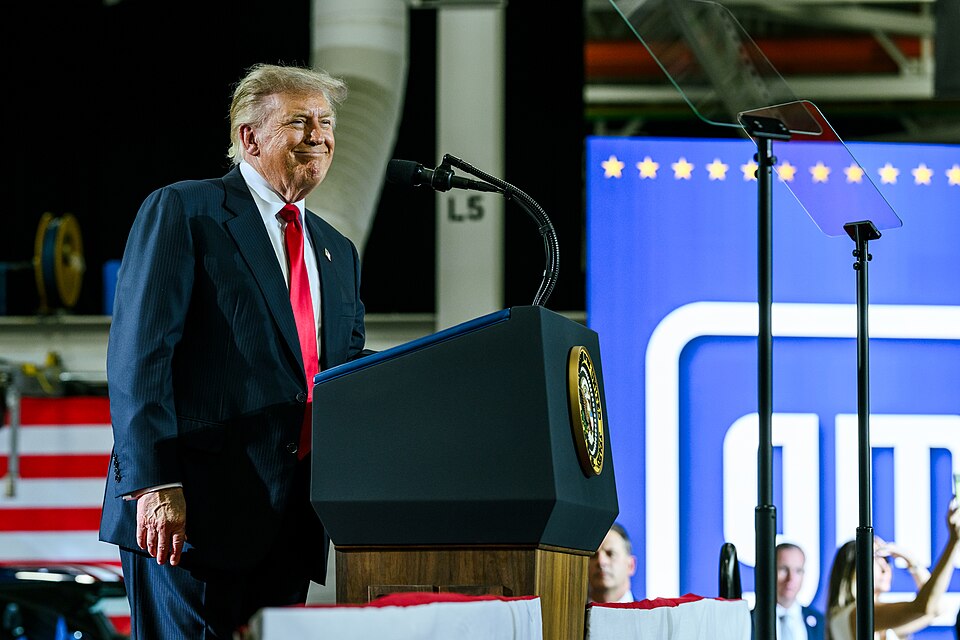
President Donald Trump is sounding the alarm over what he says is a serious national security issue connected to the legal battle surrounding his White House ballroom project.
Trump accused the National Trust for Historic Preservation, the organization suing his administration over the massive construction project, of revealing sensitive military information as part of the court fight.
The explosive allegation comes as the Trump administration takes its case to the U.S. Supreme Court, arguing that construction should be allowed to continue because the development includes important security infrastructure intended to protect the president and other senior government officials.
The National Trust, meanwhile, maintains that the administration must comply with federal law and judicial oversight before moving ahead with the project.
The escalating fight has transformed what began as a controversy over a White House ballroom into a much larger debate involving presidential security, congressional authority, historic preservation and potentially sensitive military infrastructure.
Trump Sounds Alarm Over Military Information
Trump unleashed his criticism Friday evening in a post on Truth Social.
“These are the TREASONISTS that brought the suit against the Military Complex,” Trump wrote, before alleging, “They revealed Top Military Secrets!”
The president went on to describe the organization as “very bad for our Country.”
Trump’s accusation is significant, but it should be emphasized that it represents the president’s characterization of what occurred. The allegation itself does not establish that legally classified information was improperly disclosed.
Still, Trump’s comments underscore how dramatically the administration’s description of the ballroom project has evolved.
This is no longer being presented simply as a new location for state dinners, ceremonies and major White House gatherings.
The administration says the broader development includes security and military components designed to address threats facing the presidency.
Trump Says Project Is Vital To National Security
Trump argued that the organization challenging his administration has interfered with worthwhile projects in the past and is now attempting to stop one that he considers essential.
According to the president, the White House development is “vital to our National Security” and to protecting current and future presidents, their families, staff members and Cabinet officials.
That argument could resonate with Americans concerned about the safety of the nation’s leaders following a period of heightened political violence and threats against public officials.
For Trump, the issue appears straightforward: If security professionals believe improvements are necessary to protect the president and the White House, he believes the government should be able to complete them.
His opponents see a very different issue.
They argue that even projects involving the White House must comply with federal law, congressional authority and established review procedures.
That disagreement is now headed toward the highest court in the country.
Supreme Court Asked To Step In
The Justice Department asked the Supreme Court on Friday to intervene in the ballroom dispute after the administration suffered a setback in the lower courts.
The administration wants construction to continue while the larger legal battle proceeds.
A federal appeals court recently blocked the project after concluding that the administration lacked the necessary congressional authorization for the construction. The administration disputes that interpretation and is seeking Supreme Court intervention.
The legal dispute is particularly complicated because the development includes both above-ground and underground components.
While above-ground construction has faced court restrictions, underground security-related work has been treated differently during portions of the litigation.
Trump says separating those components makes little practical sense.
“The lower section does not work without the upper section, and likewise, the upper section does not work without the lower,” Trump said.
“It is all one highly integrated unit.”
That distinction could become important as the courts determine how much of the development can proceed.
What Is Actually Being Built At The White House?
The ballroom itself is planned as a roughly 90,000-square-foot addition, but the larger development reportedly contains extensive security infrastructure.
The administration has described the project as incorporating major defensive and protective features, including below-ground facilities.
That has allowed Trump’s lawyers to argue that stopping construction isn’t merely delaying a ballroom.
From their perspective, it could interfere with a broader security project at one of the most sensitive locations in the United States.
The administration has cited threats against Trump as part of its justification for strengthening White House security. Recent court filings have emphasized the dangers presidents can face and the need for modern protective infrastructure.
The legal challengers have not accepted the argument that national security concerns allow the administration to bypass requirements they believe apply to the project.
National Trust Fires Back At Trump Administration
The National Trust for Historic Preservation has strongly rejected the administration’s attempt to keep construction moving.
After the Justice Department submitted its emergency Supreme Court request, the organization described the move as “audacious.”
The group accused the administration of trying to evade legal scrutiny and urged the Supreme Court to reject its request to continue construction during the appeal.
The National Trust’s position centers on the rule of law and historic preservation.
The organization argues that the administration should not be allowed to move forward with such a significant alteration of the White House complex without satisfying the legal requirements governing the property.
That sets up two sharply different narratives.
Trump says the project is fundamentally connected to national security and presidential protection.
His opponents say the administration cannot use those concerns to escape congressional and judicial oversight.
Bigger Questions Surround Trump’s Accusation
Trump’s allegation about military information adds another major question to the controversy.
How much information about sensitive presidential security systems should become public when a construction project ends up in federal court?
Court cases generally require both sides to produce evidence supporting their arguments. But projects involving military installations, presidential protection or classified security measures can present unusual challenges.
The government has procedures for handling classified information in legal proceedings, and Trump’s allegation does not by itself demonstrate that classified material was unlawfully released.
Nevertheless, the president clearly believes too much information about the project’s military dimensions has entered the public debate.
For Americans concerned about national security, that issue could ultimately become just as important as the fight over the ballroom itself.
A $400 Million Fight Over Presidential Power
Recent reports have placed the ballroom project’s cost at approximately $400 million, making it one of the most closely watched White House construction controversies in modern history.
But money is increasingly becoming only one part of the story.
The dispute now touches on some much larger constitutional questions.
How much authority does a president have to modify the White House?
When does Congress have to approve those changes?
How should historic preservation laws apply when national security infrastructure is involved?
And how much power should federal courts have to halt construction when an administration says presidential safety could be affected?
Those questions could have consequences extending well beyond Trump’s current project.
Supreme Court Battle Could Have Lasting Consequences
The Supreme Court has not yet resolved the underlying dispute, leaving the future of the ballroom project uncertain.
A decision favoring the administration could allow construction to move forward while Trump continues fighting the lawsuit.
A ruling against the administration could reinforce the lower court’s restrictions and potentially strengthen Congress’s role in approving major White House construction projects.
Either way, the controversy has become about much more than building a ballroom.
It is now a confrontation involving the presidency, Congress, federal courts, historic preservation advocates and national security concerns.
Trump has made his position clear: He considers the above-ground ballroom and underground security infrastructure parts of one interconnected project necessary to protect America’s presidents.
The National Trust maintains that even those arguments do not place the administration above legal review.
Now the Supreme Court could determine which argument prevails — and its decision could shape not only Trump’s White House project, but the limits of presidential power over America’s most famous government building for years to come.