Here’s what happened.
President Donald Trump suffered a major legal setback Friday after a federal appeals court ordered most construction on his ambitious White House ballroom project to stop, setting up another potentially consequential battle at the U.S. Supreme Court.
In a 2-1 decision, a panel of the U.S. Court of Appeals for the D.C. Circuit ruled that most above-ground construction cannot continue while the legal fight plays out.
The ruling does not completely shut down the project. The court is allowing certain underground work to proceed, including construction associated with security features that Trump says are important for protecting the White House and future presidents.
Trump wasted little time responding.
The president announced that he intends to appeal the decision to the Supreme Court, arguing that the ballroom project is privately financed and includes national security improvements.
The appeals court has delayed implementation of its order for two weeks, giving the Supreme Court an opportunity to consider Trump’s request for emergency intervention.
That means the fight over Trump’s White House ballroom is far from finished.
Appeals Court Blocks Major Part of Trump’s White House Project
At the heart of the dispute is a larger constitutional question involving the powers of the president and Congress.
The appeals court majority determined that Congress retains authority over funding and development involving the White House and concluded that lawmakers had not authorized Trump’s ballroom project.
The majority also emphasized the unusual scale of the construction.
The judges said they were unaware of a previous example in American history in which a president independently used privately raised money to demolish substantial portions of the White House that Congress had authorized and taxpayers had financed.
Trump and his supporters see the situation differently.
The president has emphasized that private money is financing the ballroom and has argued that the project should not require additional approval from Congress.
That argument was not enough to convince the appeals court majority.
Obama and Biden Appointees Form Majority
The three-judge panel divided 2-1.
Judges Patricia Millett and Brad Garcia formed the majority. Millett was appointed by former President Barack Obama, while Garcia was appointed by former President Joe Biden.
Judge Neomi Rao, who was appointed by Trump, dissented.
Rao strongly criticized the decision and questioned whether the National Trust for Historic Preservation, the organization challenging Trump’s project, had the legal standing required to bring the lawsuit.
She also argued that the construction likely falls within the president’s authority.
Rao warned that the judiciary was improperly inserting itself into management of construction at the White House.
In her view, the injunction extends beyond the appropriate role of federal courts, meaning construction should be permitted to continue.
That disagreement could become increasingly important if the case reaches the Supreme Court.
Trump Announces Immediate Supreme Court Appeal
Trump responded to Friday’s ruling with a lengthy statement on Truth Social.
The president said his administration would immediately appeal to the Supreme Court and sharply criticized the lower court’s decision.
Trump described the ruling as politically motivated and unlawful while arguing that the construction involves important national security considerations.
According to Trump, both the military and Secret Service view parts of the project as important to the security of the White House complex.
The president has repeatedly argued that the National Trust for Historic Preservation should not have legal standing to interfere with the project.
If the Supreme Court ultimately agrees with that argument, the question of standing could potentially become as important as the broader debate over Trump’s presidential authority.
What Trump Wants to Build at the White House
Trump’s plans extend far beyond a modest renovation.
The proposed White House ballroom is expected to encompass approximately 90,000 square feet and cost hundreds of millions of dollars.
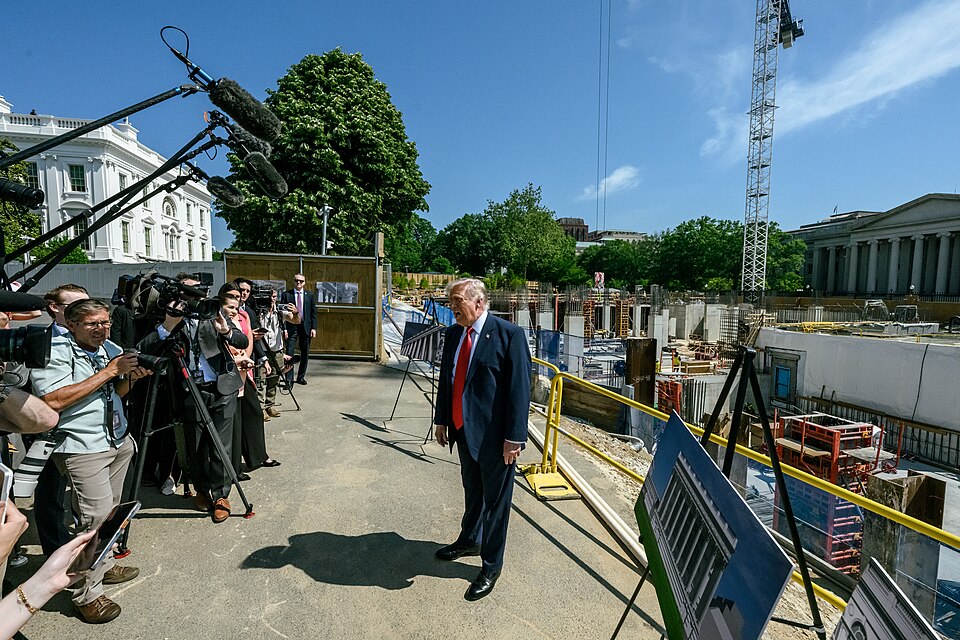
The East Wing was demolished last fall to make room for the project.
Trump has promoted the ballroom as a major improvement to the White House, providing a permanent space capable of accommodating large official events, state dinners and other important gatherings.
The ballroom is also part of Trump’s broader effort to reshape portions of Washington during his second term.
Other plans involving a golf course, an arch, the Kennedy Center and the Reflecting Pool have attracted legal challenges of their own.
But the White House ballroom has become particularly controversial because it involves significant changes to one of America’s most recognizable and historically important buildings.
Private Funding Becomes Key Part of Trump’s Argument
Money is another major issue in the legal battle.
The ballroom is expected to cost hundreds of millions of dollars, with major companies and other private donors contributing toward the project.
Trump has argued that this private financing is crucial.
His position is that because taxpayers are not being asked to provide all of the money necessary for the project, additional congressional approval should not be required.
The appeals court majority rejected the idea that private financing, by itself, settles the question.
The court’s reasoning suggests the dispute involves more than simply determining who is paying the bill. It also involves the respective constitutional authority of Congress and the president over major changes to the White House.
That question could ultimately have consequences extending well beyond Trump’s current construction project.
National Security Becomes Major Issue
The Trump administration is also emphasizing national security.
Trump has argued that the construction includes security upgrades intended to strengthen protection of the White House complex following recent shootings near locations connected to the president.
He has said the plans include a drone port and military facility.
Those security components appear to be one reason the appeals court did not order every aspect of construction to stop.
The judges allowed below-ground work connected to security infrastructure to continue.
Some above-ground construction may also proceed when it is strictly necessary to protect the underground improvements.
As a result, construction crews will not necessarily disappear from the White House grounds while the Supreme Court considers whether to intervene.
Trump Says Project Will Protect Future Presidents
Trump has stressed that the security improvements are not intended solely for his own presidency.
He argues that the project will benefit future presidents and strengthen protection surrounding the White House for years to come.
In his response to the appeals court ruling, Trump said the military and Secret Service viewed the decision as a national security concern because the new complex includes protective features.
Critics, however, maintain that even privately financed construction must comply with constitutional and legal requirements.
That disagreement now sits at the center of a rapidly escalating court battle.
Preservation Group Celebrates Court Victory
The National Trust for Historic Preservation welcomed the appeals court’s decision.
Tad Heuer, an attorney with Foley Hoag representing the organization, said the ruling supports its position that the president must obtain authorization from Congress before proceeding with the ballroom.
The group has urged Trump to stop additional construction until the litigation is resolved or Congress provides authorization.
Trump has shown no indication that he intends to abandon the project.
Instead, he is taking the fight directly to the Supreme Court.
Why the Supreme Court Battle Matters
The dispute could have implications far beyond the construction of a ballroom.
One of the central questions is how much authority a president possesses to make substantial changes to the White House without receiving specific congressional approval.
Trump’s attorneys can point to the use of private financing and the president’s responsibility for White House operations and security.
Opponents can argue that the historical importance of the property and Congress’s constitutional powers prevent a president from acting entirely on his own.
There is also the separate question of whether the organization challenging Trump has the legal standing necessary to pursue the lawsuit.
Those issues could make the case an important test of presidential authority.
Trump Still Has a Path Forward
Friday’s appeals court ruling is unquestionably a setback for Trump’s plans, but it does not mean the White House ballroom has been permanently blocked.
Several important developments remain possible.
The Supreme Court could intervene and allow broader construction to resume. Trump could eventually prevail as the underlying lawsuit proceeds. Congress could also become more directly involved in determining the project’s future.
Meanwhile, underground work involving approved security infrastructure can continue.
The two-week pause before the appeals court’s restrictions take full effect gives Trump a critical window to make his case before the Supreme Court.
For now, the president’s massive White House construction project faces one of its biggest obstacles yet.
But with Trump promising an immediate Supreme Court appeal — and with some construction still permitted — the final chapter in the battle over the White House ballroom has yet to be written.